|
|
 Shelter Dog Lover
Posts: 10277
  
| Took him in yesterday to get looked at, not off but felt a little funny in a run I made Saturday. At the vet on hard ground he was short stepping a little in rear and off a few steps in the front when he went right- vet said off in front from rear, blocked his stifle (old injury) then he was really off in the front, not bad but obviously sore. He had new shoes last Thursday. Blocked his right foot and went sound. Vet said he is "too flat"- put him in wedges for a few shoeings to bring up angle in heel. Wants the heel to spread some so be careful with the wedges because they can inhibit heel. Bones coming up from hoof should be in a straight line and not concaving in. I had this horse in to the same clinic, different vet in January and the vet said he had never seen him move better. Can this happen with just one or two shoeings? I have used the same farrier for years and have always been told by my vet that my horses feet look good.
Edited by rodeomom3 2014-04-01 11:21 AM
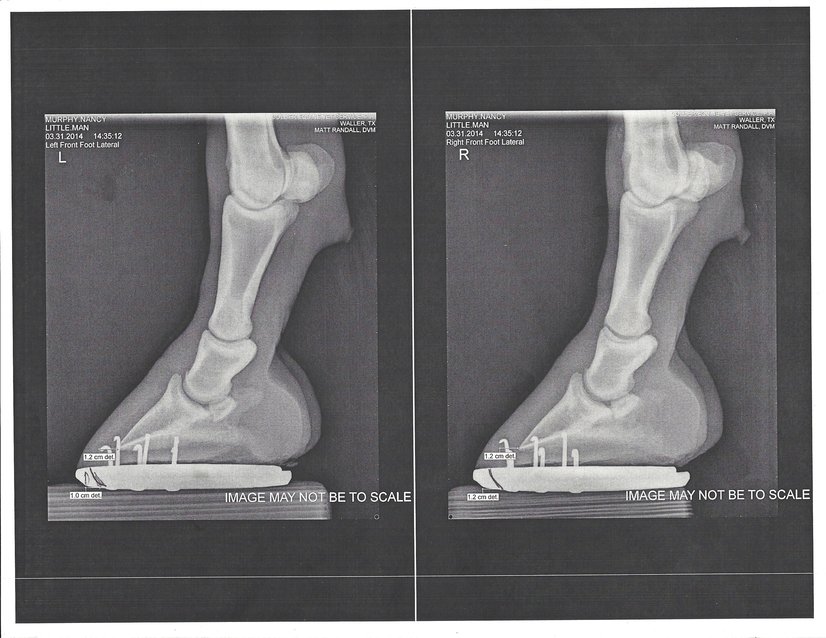 (rsz_feet.jpg) (rsz_feet.jpg)
Attachments
----------------
 rsz_feet.jpg (90KB - 289 downloads) rsz_feet.jpg (90KB - 289 downloads)
| |
| | |
  Damn Yankee
Posts: 12390

Location: Somewhere between raising hell and Amazing Grace | Do you have photos of just his foot? I agree his heel needs raised. Just my opinion but his angles look awful in the films. But then I'm no expert. | |
| | |
The Advice Guru
Posts: 6419

| There is something the matter with the coffin bone. The horse looks like a degree or two rotation. The right foot the coffin joint is fuzzy, I would have had the vet reshoot this one, and where are the other two views?
The horse also has too much toe on both feet also the feet look at different angles.
Which block did the vet use? Did he use hoof testers?
I personally would get a second opinion with three views of each foot | |
| | |
Shelter Dog Lover
Posts: 10277
| cheryl makofka - 2014-04-01 11:51 AM There is something the matter with the coffin bone. The horse looks like a degree or two rotation. The right foot the coffin joint is fuzzy, I would have had the vet reshoot this one, and where are the other two views? The horse also has too much toe on both feet also the feet look at different angles. Which block did the vet use? Did he use hoof testers? I personally would get a second opinion with three views of each foot
I don't know what block he used, will have to call and ask, very minimal reaction in heels to hoof testers, negative every where else. I am going for a second opinion Thursday. | |
| | |
Damn Yankee
Posts: 12390
Location: Somewhere between raising hell and Amazing Grace | rodeomom3 - 2014-04-01 1:01 PM cheryl makofka - 2014-04-01 11:51 AM There is something the matter with the coffin bone. The horse looks like a degree or two rotation. The right foot the coffin joint is fuzzy, I would have had the vet reshoot this one, and where are the other two views? The horse also has too much toe on both feet also the feet look at different angles. Which block did the vet use? Did he use hoof testers? I personally would get a second opinion with three views of each foot I don't know what block he used, will have to call and ask, very minimal reaction in heels to hoof testers, negative every where else. I am going for a second opinion Thursday.
Where are you going? Would be possible at all to take his shoes off to do films as well? I actually just called my vet and asked them to email me photos of my mares xrays from last October because they were impressed with her plantar angles and I wanted to show them to you. I agree that the film of the right one looks tricky. Blurry at the heel but it almost appears like the coffin bone is slightly rotated. Could easily be the angle of the xray. How many films/different angles did they take? | |
| | |
The Advice Guru
Posts: 6419
| rodeomom3 - 2014-04-01 12:01 PM
cheryl makofka - 2014-04-01 11:51 AM There is something the matter with the coffin bone. The horse looks like a degree or two rotation. The right foot the coffin joint is fuzzy, I would have had the vet reshoot this one, and where are the other two views? The horse also has too much toe on both feet also the feet look at different angles. Which block did the vet use? Did he use hoof testers? I personally would get a second opinion with three views of each foot
I don't know what block he used, will have to call and ask, very minimal reaction in heels to hoof testers, negative every where else. I am going for a second opinion Thursday.
If they are testing positive to heels I have found this generally means contracted heels or navicular.
Make sure all three views are done, make sure they are clear, also ask lots of questions, take notes.
I would take to a different vet clinic, as I have found vets in the same clinic will stick together and not look at the same horse with an open mind.
Good luck | |
| | |
Shelter Dog Lover
Posts: 10277
| cheryl makofka - 2014-04-01 12:07 PM rodeomom3 - 2014-04-01 12:01 PM cheryl makofka - 2014-04-01 11:51 AM There is something the matter with the coffin bone. The horse looks like a degree or two rotation. The right foot the coffin joint is fuzzy, I would have had the vet reshoot this one, and where are the other two views? The horse also has too much toe on both feet also the feet look at different angles. Which block did the vet use? Did he use hoof testers? I personally would get a second opinion with three views of each foot I don't know what block he used, will have to call and ask, very minimal reaction in heels to hoof testers, negative every where else. I am going for a second opinion Thursday. If they are testing positive to heels I have found this generally means contracted heels or navicular. Make sure all three views are done, make sure they are clear, also ask lots of questions, take notes. I would take to a different vet clinic, as I have found vets in the same clinic will stick together and not look at the same horse with an open mind. Good luck
Thanks! | |
| | |
The Advice Guru
Posts: 6419
| Also from the X-rays it looks like your horse should have one size bigger shoe, it looks like he has no heel support.
I had a horse that had the exact same symptoms as yours, he had contracted heels, it takes an entire years commitment to fix the problem, and the farrier has to be on the same page.
A good farrier should be leaving 1/8" of the shoe exposed all the way around the hoof wall, they also need to rasp the front of the foot off from the cornet to the ground (this allows the foot to expand). They also need to pare away the sole 1/4" all the way around the frog (the sole needs to be thin in this area to allow the frog to drop the heels to move outward when the weight is placed on that foot, when the weight is off of the foot the frog goes back into the foot and the heels come in.)
My vet had the farrier pare away where the frog and sole connect till he hit blood. This sounds barbaric but my horse never went lame, and it worked. | |
| | |
Damn Yankee
Posts: 12390
Location: Somewhere between raising hell and Amazing Grace | Just food for thought, not all navicular will show up just on xrays.
My mare was "not right" for a long time. She was never lame. By all appearances was sound to ride. But she started smashing barrels left and right. I couldn't keep them up to save my life. Over the course of 18 months we xrayed her three times. Once in the beginning, once in the middle, and once last october. First two times she failed her flex test miserably on her right front (did all the bocks etc) but nothing showed up on her xrays. I bet we spent 10k till it was all over (18 months). We xrayed front feet, ankles, knees, hocks, stifles, neck..........
Finally last october we saw very very slight cartilage changes on the bottom of her right navicular bone. Not enough to officially say navicular, but enough to "assume" that an MRI would indeed show soft tissue damange and ligament involvement from the cartilage changes. I opted to not do the MRI because it wasn't going to change the plans for her.
At the time of her last xrays, her angles looked awesome and she was being shod correctly. We had tried several different shoeing options, none of which helped. Put her on TLC equibone. Never really saw a difference. I had quit riding her August of last year. I rode her once time in January of this year and didn't like how she felt, not lame but still not right.
Five weeks ago I opted to yank her shoes off. Simply financial decision. I rode her last sunday and that was the soundest she has been in two years, she even cruised a beautfil pattern in a training bosal :) Now I have no intentions of bringing her out of retirement. But I do plan on xraying her at least once a year to document changes. | |
| | |
Damn Yankee
Posts: 12390
Location: Somewhere between raising hell and Amazing Grace | cheryl makofka - 2014-04-01 1:23 PM Also from the X-rays it looks like your horse should have one size bigger shoe, it looks like he has no heel support. I had a horse that had the exact same symptoms as yours, he had contracted heels, it takes an entire years commitment to fix the problem, and the farrier has to be on the same page. A good farrier should be leaving 1/8" of the shoe exposed all the way around the hoof wall, they also need to rasp the front of the foot off from the cornet to the ground (this allows the foot to expand). They also need to pare away the sole 1/4" all the way around the frog (the sole needs to be thin in this area to allow the frog to drop the heels to move outward when the weight is placed on that foot, when the weight is off of the foot the frog goes back into the foot and the heels come in.) My vet had the farrier pare away where the frog and sole connect till he hit blood. This sounds barbaric but my horse never went lame, and it worked.
Every horse is different....if I had a farrier that did what yours does, I would fire him before he finished. As long as it works for you and your horses, then that's all that matter though!! | |
| | |
The Advice Guru
Posts: 6419
| missroselee - 2014-04-01 12:24 PM
cheryl makofka - 2014-04-01 1:23 PM Also from the X-rays it looks like your horse should have one size bigger shoe, it looks like he has no heel support. I had a horse that had the exact same symptoms as yours, he had contracted heels, it takes an entire years commitment to fix the problem, and the farrier has to be on the same page. A good farrier should be leaving 1/8" of the shoe exposed all the way around the hoof wall, they also need to rasp the front of the foot off from the cornet to the ground (this allows the foot to expand). They also need to pare away the sole 1/4" all the way around the frog (the sole needs to be thin in this area to allow the frog to drop the heels to move outward when the weight is placed on that foot, when the weight is off of the foot the frog goes back into the foot and the heels come in.) My vet had the farrier pare away where the frog and sole connect till he hit blood. This sounds barbaric but my horse never went lame, and it worked.
Every horse is different....if I had a farrier that did what yours does, I would fire him before he finished. As long as it works for you and your horses, then that's all that matter though!!
This was all under vet supervision | |
| | |
Damn Yankee
Posts: 12390
Location: Somewhere between raising hell and Amazing Grace | cheryl makofka - 2014-04-01 1:30 PM missroselee - 2014-04-01 12:24 PM cheryl makofka - 2014-04-01 1:23 PM Also from the X-rays it looks like your horse should have one size bigger shoe, it looks like he has no heel support. I had a horse that had the exact same symptoms as yours, he had contracted heels, it takes an entire years commitment to fix the problem, and the farrier has to be on the same page. A good farrier should be leaving 1/8" of the shoe exposed all the way around the hoof wall, they also need to rasp the front of the foot off from the cornet to the ground (this allows the foot to expand). They also need to pare away the sole 1/4" all the way around the frog (the sole needs to be thin in this area to allow the frog to drop the heels to move outward when the weight is placed on that foot, when the weight is off of the foot the frog goes back into the foot and the heels come in.) My vet had the farrier pare away where the frog and sole connect till he hit blood. This sounds barbaric but my horse never went lame, and it worked. Every horse is different....if I had a farrier that did what yours does, I would fire him before he finished. As long as it works for you and your horses, then that's all that matter though!! This was all under vet supervision
I would probably fire the vet too then :)
Seriously, I'm just saying it definitely would not be for me. I'm not saying it's wrong or right. Obviously it works for you and you are happy with it so that's all that is important. I'm just pointing out that just like everything else, different things for different people/horses. | |
| | |
The Advice Guru
Posts: 6419
| missroselee - 2014-04-01 12:34 PM
cheryl makofka - 2014-04-01 1:30 PM missroselee - 2014-04-01 12:24 PM cheryl makofka - 2014-04-01 1:23 PM Also from the X-rays it looks like your horse should have one size bigger shoe, it looks like he has no heel support. I had a horse that had the exact same symptoms as yours, he had contracted heels, it takes an entire years commitment to fix the problem, and the farrier has to be on the same page. A good farrier should be leaving 1/8" of the shoe exposed all the way around the hoof wall, they also need to rasp the front of the foot off from the cornet to the ground (this allows the foot to expand). They also need to pare away the sole 1/4" all the way around the frog (the sole needs to be thin in this area to allow the frog to drop the heels to move outward when the weight is placed on that foot, when the weight is off of the foot the frog goes back into the foot and the heels come in.) My vet had the farrier pare away where the frog and sole connect till he hit blood. This sounds barbaric but my horse never went lame, and it worked. Every horse is different....if I had a farrier that did what yours does, I would fire him before he finished. As long as it works for you and your horses, then that's all that matter though!! This was all under vet supervision
Seriously, I'm just saying it definitely would not be for me. I'm not saying it's wrong or right. Obviously it works for you and you are happy with it so that's all that is important. I'm just pointing out that just like everything else, different things for different people/horses.
Pete Ramsay's book also explains paring away the sole around the frog. Page 51 not as drastic to trimming to blood.
Also contracted heels left untreated can cause navicular due to inflammation and poor blood circulation in the foot.
Each person to their own.
| |
| | |
Damn Yankee
Posts: 12390
Location: Somewhere between raising hell and Amazing Grace | cheryl makofka - 2014-04-01 2:34 PM missroselee - 2014-04-01 12:34 PM cheryl makofka - 2014-04-01 1:30 PM missroselee - 2014-04-01 12:24 PM cheryl makofka - 2014-04-01 1:23 PM Also from the X-rays it looks like your horse should have one size bigger shoe, it looks like he has no heel support. I had a horse that had the exact same symptoms as yours, he had contracted heels, it takes an entire years commitment to fix the problem, and the farrier has to be on the same page. A good farrier should be leaving 1/8" of the shoe exposed all the way around the hoof wall, they also need to rasp the front of the foot off from the cornet to the ground (this allows the foot to expand). They also need to pare away the sole 1/4" all the way around the frog (the sole needs to be thin in this area to allow the frog to drop the heels to move outward when the weight is placed on that foot, when the weight is off of the foot the frog goes back into the foot and the heels come in.) My vet had the farrier pare away where the frog and sole connect till he hit blood. This sounds barbaric but my horse never went lame, and it worked. Every horse is different....if I had a farrier that did what yours does, I would fire him before he finished. As long as it works for you and your horses, then that's all that matter though!! This was all under vet supervision
Seriously, I'm just saying it definitely would not be for me. I'm not saying it's wrong or right. Obviously it works for you and you are happy with it so that's all that is important. I'm just pointing out that just like everything else, different things for different people/horses. Pete Ramsay's book also explains paring away the sole around the frog. Page 51 not as drastic to trimming to blood. Also contracted heels left untreated can cause navicular due to inflammation and poor blood circulation in the foot. Each person to their own.
I wasn't arguing the contracted heels comment. I'm not sure why you feel like I'm arguing with you.
I am not. I am not saying your farrier is wrong. You shared your thoughts and I shared mine. That is all.
No different then you may like a saddle that I hate. That's the beauty of all this. We have the freedom to make choices to what works best for each of us.
Please don't take this whole thing so personally. | |
| |
|