|
|
Miss Not Exciting
Posts: 3279
   
Location: Ft Worth TX | You have a wide array of horse people and how they feed dependent on what they do! So let's hear some input! I hear people that like high protein, some like all fat, heck I have even heard some say high fiber!
I personally feed all alfalfa and a 12/10 or 12/8 grain to the ones that need it! |
|
| |
|
 Elite Veteran
Posts: 974

Location: USA | I feed ADM Alliance PRIMEGLO to my broodmares and one gets additional fat added. They have free choice GROSTRONG minerals and are on grass pasture. They also get a flake of alfalfa if I feel it's needed. All the babies get JUNIORGLO. Everyone gets free choice coastal in the winter and summer if my pastures dry up from this drought. |
|
| |
|
Expert
Posts: 3514
| I feed Renew gold and oats. 1 1/2 lbs of renew gold and 1 lb of oats divided into two feedings. Alfalfa and Timothy Hay. Then Platinum Performance CJ |
|
| |
|
Rad Dork
Posts: 5218

Location: Oklahoma | My guy is on Purina Strategy Healthy Edge & Sweet Feed (which I'm currently weaning him off of), soaked alfalfa/timothy cubes (to help put on some weight) twice a day with 2 oz of rice bran oil added at night. All mixed in together. He is currently in a lot that has about 1.5 acres on it, but he's just about ate that down.
I'm also adding my THE Muscle Mass mix once it gets here in a couple of days. |
|
| |
|
 Extreme Veteran
Posts: 540
Location: My own little world :) | I feed about a cup of each rolled oats, wet cob, and rice bran then add in a scoop of northwest horse supplement and about a half a scoop of platinum performance. My horses are fat and happy and super shiny! I also haven't noticed them being to hot or anything. |
|
| |
|
 BHW Resident Surgeon
Posts: 25352
Location: Bastrop, Texas | I wish there was somewhere a person could look to really get the skinny on horse nutrition and feeding. Threads like this only tell me there are a thousand different "feeding programs" out th. ere and for most, it's probably hard to identify a significant difference, yet a lot of people think there program is the best because that's what's been working for them. Hard to argue with success. Some people feed pelleted feeds and their horses are healthy, look great, and perform well. Other's say feeding whole grains is the way to go. Some do well on grass hay and whole oats with a free choice salt and mineral lick, while others have elaborate feeding regimens. I've been having an ongoing debate over alfalfa because my horses get a lot of alfalfa...at least 50%. I'm told there is "too much protein" in alfalfa and too much calcium. I know that horses with normal kidney function can handle the protein and excess calcium is just excreted in the urine, just like people. I just ran into my vet at the Fleet store about a half hour ago and she says the only thing with alfalfa is that if your horses aren't used to it, you have to gradually introduce them to it, otherwise they can get bloated and gassy. The higher protein in alfalfa can give a horse more muscle mass, but I don't think that's such a bad thing. I think there is a lot of talk about calcium and phoshporus ratios, etc..., but it seems to me it's a little overblown. Horse metabolism of calcium and phosphate is the same as humans. That means we are talking about Vit D, Parathyroid hormone, Calcitonin, the intestine, the liver, bones, and kidneys. These are the players when you are talking about calcium and phosphate and the important thing to know is that the healthy kidney will excrete all the excess.
I just wish I had a list of absolute do's and don't's. When it comes to nutrition, everyone thinks their program is the best, obviously. I just wonder what really matters. |
|
| |
|
Hungarian Midget Woman
Location: Midwest | HotbearLVR - 2014-05-13 12:44 PM I wish there was somewhere a person could look to really get the skinny on horse nutrition and feeding. Threads like this only tell me there are a thousand different "feeding programs" out th. ere and for most, it's probably hard to identify a significant difference, yet a lot of people think there program is the best because that's what's been working for them. Hard to argue with success. Some people feed pelleted feeds and their horses are healthy, look great, and perform well. Other's say feeding whole grains is the way to go. Some do well on grass hay and whole oats with a free choice salt and mineral lick, while others have elaborate feeding regimens. I've been having an ongoing debate over alfalfa because my horses get a lot of alfalfa...at least 50%. I'm told there is "too much protein" in alfalfa and too much calcium. I know that horses with normal kidney function can handle the protein and excess calcium is just excreted in the urine, just like people. I just ran into my vet at the Fleet store about a half hour ago and she says the only thing with alfalfa is that if your horses aren't used to it, you have to gradually introduce them to it, otherwise they can get bloated and gassy. The higher protein in alfalfa can give a horse more muscle mass, but I don't think that's such a bad thing. I think there is a lot of talk about calcium and phoshporus ratios, etc..., but it seems to me it's a little overblown. Horse metabolism of calcium and phosphate is the same as humans. That means we are talking about Vit D, Parathyroid hormone, Calcitonin, the intestine, the liver, bones, and kidneys. These are the players when you are talking about calcium and phosphate and the important thing to know is that the healthy kidney will excrete all the excess.
I just wish I had a list of absolute do's and don't's. When it comes to nutrition, everyone thinks their program is the best, obviously. I just wonder what really matters.
don't feed them hamburgers
 |
|
| |
|
BHW Resident Surgeon
Posts: 25352
Location: Bastrop, Texas | barrelracr131 - 2014-05-13 12:46 PM HotbearLVR - 2014-05-13 12:44 PM I wish there was somewhere a person could look to really get the skinny on horse nutrition and feeding. Threads like this only tell me there are a thousand different "feeding programs" out th. ere and for most, it's probably hard to identify a significant difference, yet a lot of people think there program is the best because that's what's been working for them. Hard to argue with success. Some people feed pelleted feeds and their horses are healthy, look great, and perform well. Other's say feeding whole grains is the way to go. Some do well on grass hay and whole oats with a free choice salt and mineral lick, while others have elaborate feeding regimens. I've been having an ongoing debate over alfalfa because my horses get a lot of alfalfa...at least 50%. I'm told there is "too much protein" in alfalfa and too much calcium. I know that horses with normal kidney function can handle the protein and excess calcium is just excreted in the urine, just like people. I just ran into my vet at the Fleet store about a half hour ago and she says the only thing with alfalfa is that if your horses aren't used to it, you have to gradually introduce them to it, otherwise they can get bloated and gassy. The higher protein in alfalfa can give a horse more muscle mass, but I don't think that's such a bad thing. I think there is a lot of talk about calcium and phoshporus ratios, etc..., but it seems to me it's a little overblown. Horse metabolism of calcium and phosphate is the same as humans. That means we are talking about Vit D, Parathyroid hormone, Calcitonin, the intestine, the liver, bones, and kidneys. These are the players when you are talking about calcium and phosphate and the important thing to know is that the healthy kidney will excrete all the excess.
I just wish I had a list of absolute do's and don't's. When it comes to nutrition, everyone thinks their program is the best, obviously. I just wonder what really matters. don't feed them hamburgers
Oh hell no! Those double quarter pounders with cheese and raw onions are MINE! |
|
| |
|
Expert
Posts: 1414
| I just got done talking with my vet and an equine nutritionalist about my feeding program. My 14 year isn't thin but he's lacking muscle compared to other years and doesn't have the "bloom" like I want. He's running good but not firing like his normal self, yet at home he's been kind of a basket case. Had bloodwork done (along with an EXTENSIVE lameness exam) and everything checks out good. He was on pasture 24/7 with a very good quality free choice grass mix hay and he was getting 5 pounds of Tribute Ultra Kalm a dau. That is a low starch feed.
They think the "crazies" are coming from the high sugar content in the grass right now. I believe that because even my 4 year old who is usually Ms. Calm, Cool and Collected has been on edge lately. They feel he needs more protein to build muscle to "feed the engine". We're going to limit pasture to 6-8 hours a day and only turn them out in the afternoon or evening when the sugars have gone back down to the roots. I'll be able to turn them out longer when the new spring grass isn't so new anymore. They will continue to get hay 24/7 and we're going to switch him to 5-6 pounds a day of Tribute Kalm N Easy with 2 pounds of Essential K. They also get free choice loose vitamin/minerals.
I added a couple pictures of my 4 year old. She's much more dappled this year than last year and has more of a "fuller" look to her.
Edited by roanrider 2014-05-13 1:36 PM
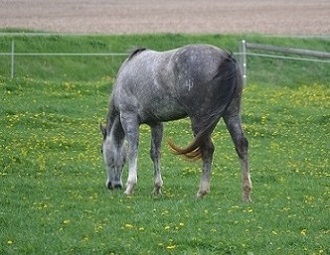 (DSC_1489 (445x334).jpg) (DSC_1489 (445x334).jpg)
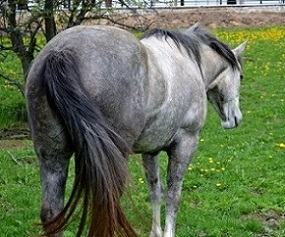 (DSC_1538 (640x427).jpg) (DSC_1538 (640x427).jpg)
Attachments
----------------
 DSC_1489 (445x334).jpg (99KB - 249 downloads) DSC_1489 (445x334).jpg (99KB - 249 downloads)
DSC_1538 (640x427).jpg (98KB - 577 downloads)
|
|
| |
|
Fire Ant Peddler
Posts: 2881
| Dreamingofcans - 2014-05-07 1:15 PM
I feed ADM Alliance PRIMEGLO to my broodmares and one gets additional fat added. They have free choice GROSTRONG minerals and are on grass pasture. They also get a flake of alfalfa if I feel it's needed. All the babies get JUNIORGLO. Everyone gets free choice coastal in the winter and summer if my pastures dry up from this drought.
Grostrong minerals are about as good as you can get especially for broodmares.
High fat is for sustained energy for endurance rides etc. Protein is for growth and repair of tissue. Fiber is nondigestable.
Several people around here have had major bladder problems feeding alfalfa. The calcium seems to build up in the bladder and create something similar to bladder stones. Most people around here feed a 14% protein feed and quality coastal hay. |
|
| |
|
 Veteran
Posts: 224
Location: So Cal | A lot of people out here feed alfalfa, partially because of how available it is and how- even though it's still expensive- it's cheaper than the other options.
I feed free choice hay that's a mix of meadow grass/Timothy/orchard, along with some alfalfa and/or alfalfa/Bermuda pellets. I also use either Triple Crown Senior or Integrity Senior along with their supplements. My main mare gets Smooth Run Pro, which finally helps her keep weight on, and the other gets the Breathe Smooth to keep her bug allergies away.
One of the most important things to me is keeping them grazing on something all the time, which is why I like the hay I get that they don't eat super fast but just eat throughout the day. Keeps them busy and keeps their stomach happier. My easy keeper ponies I buy a grass/alfalfa mix for, no grain. (No pastures here!) |
|
| |
|
Rad Dork
Posts: 5218
Location: Oklahoma | Curious about the protein and alfalfa consumption....
The main (bigger portion, as I'm decreasing the sweet feed) feed my gelding gets is 12.5% protein and he's getting Standlee Alfalfa/Timothy cubes with 12% protein. Is that too much protein? I went with the A/T mixture as it says it's good for performance horses and underweight horses. He's not in terrible condition and maybe it's because he's race bred that I think he's so thin bone thin, but I don't like seeing his tailbone as much it's being shown... Just want to add a bit of fat to him and help build up his topline. I'm not sure if I need more fat or protien since I'm wanting to bulk him up but also keep in on a diet where his back will muscle up. |
|
| |
|
BHW Resident Surgeon
Posts: 25352
Location: Bastrop, Texas | My question is what constitutes "too much protein" and why? If grass hay is say 11-12% and alfalfa is say 20-21%, what's wrong with feeding all alfalfa? My alfalfa costs the same as mixed grass ($4.50/60-70 lb square bale). |
|
| |
|
The Advice Guru
Posts: 6419
| HotbearLVR - 2014-05-13 4:20 PM
My question is what constitutes "too much protein" and why? If grass hay is say 11-12% and alfalfa is say 20-21%, what's wrong with feeding all alfalfa? My alfalfa costs the same as mixed grass ($4.50/60-70 lb square bale).
I don't know what is too high of protein, as horses respond differently to high amounts of anything.
I do know too much protein can cause kidney stones.
I agree with no specific info. I bought a nutrition in horses book and it never really went into depth about the ratios and the effects or consequences, but spoke about too much or little selenium. |
|
| |
|
 Peecans
| HotbearLVR - 2014-05-13 11:44 AM
I wish there was somewhere a person could look to really get the skinny on horse nutrition and feeding. Threads like this only tell me there are a thousand different "feeding programs" out th. ere and for most, it's probably hard to identify a significant difference, yet a lot of people think there program is the best because that's what's been working for them. Hard to argue with success. Some people feed pelleted feeds and their horses are healthy, look great, and perform well. Other's say feeding whole grains is the way to go. Some do well on grass hay and whole oats with a free choice salt and mineral lick, while others have elaborate feeding regimens. I've been having an ongoing debate over alfalfa because my horses get a lot of alfalfa...at least 50%. I'm told there is "too much protein" in alfalfa and too much calcium. I know that horses with normal kidney function can handle the protein and excess calcium is just excreted in the urine, just like people. I just ran into my vet at the Fleet store about a half hour ago and she says the only thing with alfalfa is that if your horses aren't used to it, you have to gradually introduce them to it, otherwise they can get bloated and gassy. The higher protein in alfalfa can give a horse more muscle mass, but I don't think that's such a bad thing. I think there is a lot of talk about calcium and phoshporus ratios, etc..., but it seems to me it's a little overblown. Horse metabolism of calcium and phosphate is the same as humans. That means we are talking about Vit D, Parathyroid hormone, Calcitonin, the intestine, the liver, bones, and kidneys. These are the players when you are talking about calcium and phosphate and the important thing to know is that the healthy kidney will excrete all the excess.
I just wish I had a list of absolute do's and don't's. When it comes to nutrition, everyone thinks their program is the best, obviously. I just wonder what really matters.
Our nutrionilist for the feed lot (he also with dairy barns and pigs as well) is gathering g me all the info and research behind all the horse feed and mineral that they now have. As they have recently merged with a company that does horses. If you want I could forward the reading to you if its any good.
The "horse guy" is suposto come with Erwin the next time hes in the area as well for a visit. |
|
| |
|
 Chasin my Dream
Posts: 13651
Location: Alberta | I'll say one thing I don't think I've seen mention (or has and I've missed it) is how living in different areas does affect the needs of horses....as per what minerals are present or not in the soil the feed is produced AND the quality of a forage. I could probably guess alfalfa grown in the dark black soul up here would read different on a test of alfalfa grown in southern states! I think reading different articles on nutrition is good but ones pin pointed for YOUR AREA is a key factor. Sure your protein, lysine, calcium & phosphorus % in the diet will be the same across the country ( as per age of horse & activity levels) but the feed produced content won't likely...I'm not talking manufactured feeds, cause those you have labels to refer to.
We feed only forage, whether it's pasture, hay or alfalfa cubes and have never had to add grain to diets. Our horses look good, do good under even steady hauling in the summer....they do get a mineral made locally. I feel very lucky to have access to very good quality feed...
Edited by dream_chaser 2014-05-13 6:17 PM
|
|
| |
|
Expert
Posts: 1314
Location: North Central Iowa Land of white frozen grass | In my opinion which is worth what you want it to be. Is with all the research that has been done by all the feed company's and university's. If their was a perfect way to feed horses we would all be doing it the same way. Their is no perfect way to feed or one way would stand out above all the rest.
Edited by BS Hauler 2014-05-13 6:15 PM
|
|
| |
|
BHW Resident Surgeon
Posts: 25352
Location: Bastrop, Texas | BS Hauler - 2014-05-13 6:13 PM In my opinion which is worth what you want it to be. Is with all the research that has been done by all the feed company's and university's. If their was a perfect way to feed horses we would all be doing it the same way. Their is no perfect way to feed or one way would stand out above all the rest.
That's what I think too. |
|
| |
|
Veteran
Posts: 139
Location: Abbotsford B.C. Canada | It is all about balance. Alfalfa can be used but you mujst recognize high protein may not be needed for a mature horse. Research shows feeding over 15% protein to TB race horses slows speed. Horses may tolerate excess protein but they need more water than normal to get rid of the excess nitrogen as urea. If water balance is a concern in hot weather then why over do it. Maybe stay at 50% alfalfa. The excess calcium too requires water for removal. Not a huge deal but older horses or those taht get dehydrated in hot weather do not need a large load of calcium in the kidneys. I have seen kidney stones in horse in my work with horse nutrition. NOt that often but it is there. A horse that has tied up may have a little kidney damage so less alfalfa may help that horse. Excess protein puts a metabolic load on a speed horse so energy is needed to get rid of the excess. and that creates heat.
Older horses can tolerate a 4 to one caclium phos ratio maybe higher as long as P needs are met but a baby horse should be kept closer to 1.5 to one to 2 to one max.
If you are in a speed event why lug more water around than necessary for good health, yet some alfalfa helps prevent ulcers and encourages good forage intake. Try half alfalfa for a barrel horse and see how taht works for you .
Coastal Rider |
|
| |
|
 You get what you give
Posts: 13030
Location: Texas | we feed Patriot 14-P. its a 14/6 pellet. I like it because its high enough in protein for our growing babies, but not too much. We supplement with pasture, grass hay, and some of our horses get alfalfa.
There's no one way to do it. we also feed a couple of ours omolene 200 and oats LOL. They all look good…and you couldn't pick out which one is on the omolene and oats and which ones are on the pellets. |
|
| |
|
 Shelter Dog Lover
Posts: 10277
| I don't feed any grain. My 4 horses have 80 acres to graze. I feed a cup of soaked molasses free beet pulp for fiber and moisture, renew gold for fat, vitamins and minerals, alfalfa 3 or 4 times a week. My vet loves my feed program, he thinks the ideal feed program is pasture and alfalfa. |
|
| |