|
|
Regular
Posts: 56

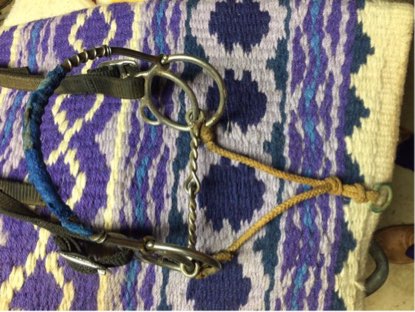
| What is the point of this?? I have seen this before but didn't get a picture of it. This one was on fb on the Bit Auction. What kind of horse would you put this on? To fix what problems??
 (IMG_3062.JPG) (IMG_3062.JPG)
Attachments
----------------
 IMG_3062.JPG (60KB - 263 downloads) IMG_3062.JPG (60KB - 263 downloads)
|
|
| |
|
 Not Afraid to Work
Posts: 4717
  
| I am assuming this would be used for a horse that needs a lot of control, probably carries his head high. I personally wouldn't use it.
Interested in other opinions. |
|
| |
|
 Miss Laundry Misshap
Posts: 5271

| To make people ask questions! LOL
That's all I've got! |
|
| |
|
I just read the headlines
Posts: 4483
| It's purpose is to cover up all the holes in the horse's training. If I have to use that bit, I need to go back to square one. Me and the horse.  |
|
| |
|
 Extreme Veteran
Posts: 425
Location: California | Best idea I can come up with is some sort of tie down/draw rein type action. With a tie down, a horse may just learn to lean against it.This being on the actual bit would make the horse work against its own self, sort of like draw reins, but for a lazy rider. As far as the thin twisted wire snaffle, that's already a fairly harsh bit. 
Edited by ccarpe18 2017-01-24 10:34 AM
|
|
| |
|
 Take a Picture
Posts: 12842
| TORTURE? |
|
| |
|
 I Don't Brag
Posts: 6960

| Looks like a combo draw/gag/snaffle tie down.
As to what it does? IMHO it takes control away. If the horse pushes in to the "tie down) all other control is basically negated, It can't draw due to said pressure and pulling back for a whoa is also negated. The only way that bit can function as a bit is if the horse does NOT put is head up or nose out, so why the tie down. IMHO it is someone's attempt to design a "new and improved" bit without really understanding function but again that is MHO. |
|
| |
|
  Whack and Roll
Posts: 6342
Location: NE Texas | This bit is more of what I would call a sidepull with a mouthpiece. The first point of contact is going to be on the nose when the reins are pulled, but there is no leverage. It's a direct rein bit and will have zero lift, but is more intended to pull a horse's nose around a turn and the shoulder follows that. IMO, being that there is no leverage, unless you are very, very strong, this bit isn't all that severe. The mouthpece slides front to back, but not up and down, so again, it's just kind of there but never really engages, but the main point of contact is noseband for a side pull effect or a horse who needs some pressure on the outside cheek through a turn or maybe gets their shoulder a little outside the turn.
I would say that the added tie down feature is for a very loose tie down strap that would only touch if a horse elevated in the turn when they should be down and digging through the turn rather than elevating at the actual turn point.
I do have a metal nosed sidepull in my arsenal, but it isn't wire wrapped and doesn't have a mouthpiece or added tie down. I love it to exercise a horse in or to use on a horse who is super light in the mouth and elevates the front end through a turn. I find it really allows a horse to finish a turn low and hard wheras a bit can sometimes get them elevating through the front end and throwing their shoulder outside of the turn.
Edited by Herbie 2017-01-24 10:55 AM
|
|
| |
|
Expert
Posts: 1611
| GLP - 2017-01-24 11:31 AM
It's purpose is to cover up all the holes in the horse's training. If I have to use that bit, I need to go back to square one. Me and the horse.
I agree.
BUT if the horse came to me in the his bit and was actually working in this bit meaning they were responsive, willing, supple, and broke in the mouth then by all means i'd leave him alone in this bit. |
|
| |
|
I Don't Brag
Posts: 6960
| I guess the wire wrapped would discourage a horse from pushing in to the tie down, but the wire wrap, to me, implies that the horse it is intended for DOES push into a tie down thus negating the other intended uses of the bit. If it works for someone I guess I say, go with what works. Myself I would be backing up and getting the horse broke better so I would need such "fixes". |
|
| |
|
I just read the headlines
Posts: 4483
| astreakinchic - 2017-01-24 11:12 AM
GLP - 2017-01-24 11:31 AM
It's purpose is to cover up all the holes in the horse's training. If I have to use that bit, I need to go back to square one. Me and the horse.
I agree.
BUT if the horse came to me in the his bit and was actually working in this bit meaning they were responsive, willing, supple, and broke in the mouth then by all means i'd leave him alone in this bit.
I agree with you that if he came with that bit I might try it, but I am not sure I would ride well with it. It would make me very cautious and hesitant. |
|
| |
|
Take a Picture
Posts: 12842
| rodeoveteran - 2017-01-24 11:13 AM
I guess the wire wrapped would discourage a horse from pushing in to the tie down, but the wire wrap, to me, implies that the horse it is intended for DOES push into a tie down thus negating the other intended uses of the bit. If it works for someone I guess I say, go with what works. Myself I would be backing up and getting the horse broke better so I would need such "fixes".
Note that tie down is attached to bit not the nose band. Should be good for making one really tough.
Edited by streakysox 2017-01-24 2:08 PM
|
|
| |
|
I Don't Brag
Posts: 6960
| streakysox - 2017-01-24 2:07 PM
rodeoveteran - 2017-01-24 11:13 AM
I guess the wire wrapped would discourage a horse from pushing in to the tie down, but the wire wrap, to me, implies that the horse it is intended for DOES push into a tie down thus negating the other intended uses of the bit. If it works for someone I guess I say, go with what works. Myself I would be backing up and getting the horse broke better so I would need such "fixes".
Note that tie down is attached to bit not the nose band. Should be good for making one really tough.
Maybe you put it more understandably than I did. But attaching the tie down to the bit itself it interferes with what one uses a bit for. Again MHO.
By tough you do not mean tough to beat but tough to control? If so, I agree. |
|
| |
|
Take a Picture
Posts: 12842
| rodeoveteran - 2017-01-24 2:18 PM
streakysox - 2017-01-24 2:07 PM
rodeoveteran - 2017-01-24 11:13 AM
I guess the wire wrapped would discourage a horse from pushing in to the tie down, but the wire wrap, to me, implies that the horse it is intended for DOES push into a tie down thus negating the other intended uses of the bit. If it works for someone I guess I say, go with what works. Myself I would be backing up and getting the horse broke better so I would need such "fixes".
Note that tie down is attached to bit not the nose band. Should be good for making one really tough.
Maybe you put it more understandably than I did. But attaching the tie down to the bit itself it interferes with what one uses a bit for. Again MHO.
By tough you do not mean tough to beat but tough to control? If so, I agree.
YEP |
|
| |
|
 Sock eating dog owner
Posts: 4557
Location: Where the pavement ends and the West begins Utah | It took me a minute to figure this out. It's not a tie down but a contraption to use as a" single rein" by attaching both reins to the ring so equal pressure is applied to both sides of the bit. some reiners and show horse riders do this to get more balance. Ropers will use a full made bit similar to this so the rope don't get caught in the bit. |
|
| |
|
Expert
Posts: 1611
| GLP - 2017-01-24 12:27 PM
astreakinchic - 2017-01-24 11:12 AM
GLP - 2017-01-24 11:31 AM
It's purpose is to cover up all the holes in the horse's training. If I have to use that bit, I need to go back to square one. Me and the horse.
I agree.
BUT if the horse came to me in the his bit and was actually working in this bit meaning they were responsive, willing, supple, and broke in the mouth then by all means i'd leave him alone in this bit.
I agree with you that if he came with that bit I might try it, but I am not sure I would ride well with it. It would make me very cautious and hesitant.
Yeah I dunno about it working with my hands. I love Kathy James bits ( I literally have one in every mouth piece) and I love the short shank version of them too instead of a regular o-ring. Obsessed with them and the Danielle Campbell line of bits too. I would actually love to have "the duke" that Flaharty makes but I work for a living so I'll stick to the L&W or carolina bits versions LOL Even the used ones are expensive! |
|
| |
|
 Elite Veteran
Posts: 670
Location: Running my kids somewhere. | Herbie - 2017-01-24 10:54 AM This bit is more of what I would call a sidepull with a mouthpiece. The first point of contact is going to be on the nose when the reins are pulled, but there is no leverage. It's a direct rein bit and will have zero lift, but is more intended to pull a horse's nose around a turn and the shoulder follows that. IMO, being that there is no leverage, unless you are very, very strong, this bit isn't all that severe. The mouthpece slides front to back, but not up and down, so again, it's just kind of there but never really engages, but the main point of contact is noseband for a side pull effect or a horse who needs some pressure on the outside cheek through a turn or maybe gets their shoulder a little outside the turn.
I would say that the added tie down feature is for a very loose tie down strap that would only touch if a horse elevated in the turn when they should be down and digging through the turn rather than elevating at the actual turn point.
I do have a metal nosed sidepull in my arsenal, but it isn't wire wrapped and doesn't have a mouthpiece or added tie down. I love it to exercise a horse in or to use on a horse who is super light in the mouth and elevates the front end through a turn. I find it really allows a horse to finish a turn low and hard wheras a bit can sometimes get them elevating through the front end and throwing their shoulder outside of the turn.
Well said. |
|
| |


 Folks on-line