|
|
Veteran
Posts: 296
 
| Here's some background - fall of 2012 my horse came up severely lame one day, hauled him in, the small what we thought was a superficial crack on his back hoof had exploded, resulting in the first picture below. Vet didn't really know what happened because it obviously wasn't an abscess - neither did my shoer. It healed up much better than I anticipated, and by last spring we were running again. Last summer another superficial crack showed up, just like the first - I've been watching it for months and months. Last night it started to blow up again. I wasn't sure what was going on - been through 2 really good shoers and nothing has been said about this crack that has kind of grown with time of course. My question is - can anything be done to avoid this? What should I be doing differently? I'm going to take him in today to hopefully get this new one cleaned up and on the right track again. Makes me sick that it's been overlooked the way it has!
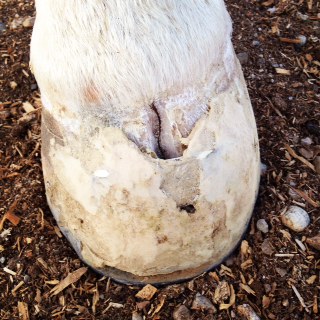 (hickups hoof 10.12.jpg) (hickups hoof 10.12.jpg)
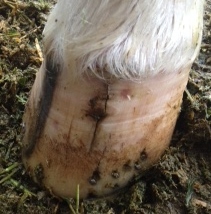 (hickups hoof 2.10.jpg) (hickups hoof 2.10.jpg)
Attachments
----------------
 hickups hoof 10.12.jpg (45KB - 342 downloads) hickups hoof 10.12.jpg (45KB - 342 downloads)
hickups hoof 2.10.jpg (51KB - 247 downloads)
|
|
| |
|
The Advice Guru
Posts: 6419
 
| I would notch it above and below the crack so it can't spread.
I also apply fish oil as per vet recommendation on the cornet band to battle dry feet.
I give my horses biotin, milk powder, and flax with their grain if I am having foot problems. The biotin helps the feet to grow, the milk powder thickens the hoof wall, and the flax I find helps to promote healthy foot and coat. |
|
| |
|
Veteran
Posts: 296
| cheryl makofka - 2014-02-11 9:06 AM
I would notch it above and below the crack so it can't spread.
I also apply fish oil as per vet recommendation on the cornet band to battle dry feet.
I give my horses biotin, milk powder, and flax with their grain if I am having foot problems. The biotin helps the feet to grow, the milk powder thickens the hoof wall, and the flax I find helps to promote healthy foot and coat.
Thanks for the good info - we obviously need to do something different here! |
|
| |
|
 Expert
Posts: 1898

| Is the new crack on the same foot in the same place?
ETA: It looks the crack is actually closer to the toe than quarter?
Edited by cyount2009 2014-02-11 9:46 AM
|
|
| |
|
  Sock eating dog owner
Posts: 4557

Location: Where the pavement ends and the West begins Utah | You need to feed a combination of DL Methionine and Biotin together one in not so good without the other. I would pull the shoes and leave barefoot for 6 weeks. Those feet need to spread some he is shod too tight, which is causing pressure on the foot. Fish oil is good, You can also use olive oil or rain maker. Take a bell boot and some a type of sheep skin material to the inside, apply the fish oil or other and leave on the hoof. Just put it on backward. That is not a quarter crack, they are on the sides of the hoof. |
|
| |
|
Expert
Posts: 1898
| cow pie - 2014-02-11 10:00 AM
You need to feed a combination of DL Methionine and Biotin together one in not so good without the other. I would pull the shoes and leave barefoot for 6 weeks. Those feet need to spread some he is shod too tight, which is causing pressure on the foot. Fish oil is good, You can also use olive oil or rain maker. Take a bell boot and some a type of sheep skin material to the inside, apply the fish oil or other and leave on the hoof. Just put it on backward. That is not a quarter crack, they are on the sides of the hoof.
I agree it's on the toe and not the quarter and barefoot is best. We had one that had a reoccurring quarter crack that started at the coronary band and it has been a battle for years. We finally after three years of suggested corrective shoeing, supplements and oils left him barefoot and continued the feed through supplements. The crack is now completely trimmed out and the hoof looks healthy and smooth, but this process has taken almost a year. On this particular horse, the crack would grow out and we get the OK to ride and then it would reopen. His is do to a genetically undershot heel.
If the hoof has been damaged for an extended amount of time or there is an infection between the horn and the white line there is most likely scar tissue growth in the horn. Until the scar tissue can grow out and be trimmed off it will continue to be reoccurring.
There is a lot of good information on the treatment and cause of hoof cracks. Google "Toe Cracks in Horses" and read all the information you can.
Reoccurring cracks are a devil of a problem.
Edited by cyount2009 2014-02-11 10:31 AM
|
|
| |
|
Veteran
Posts: 296
| I didn't really know kind of crack it was - all I knew is they've started out small, and then exploded rather quickly after months and months of doing nothing
Edited by luvrdeo 2014-02-11 11:39 AM
|
|
| |
|
Veteran
Posts: 296
| cyount2009 - 2014-02-11 9:39 AM
Is the new crack on the same foot in the same place?
ETA: It looks the crack is actually closer to the toe than quarter?
same foot, first one was dead center and this one is more to the right |
|
| |
|
 That's White "Man" to You
Posts: 5515
| I went thru the exact same thing with my head horse. An abcess is what made hers explode though. The farrier figured that when we turn the steer, there was enough flex in the hoof that a piece of sand could have entered the hoof. We did the following to help:
- Take off pasture and keep her in a dry lot (this had the most impact)
- Keep on an egg bar type shoe to keep the hoof from flexing
- we use garden hose clamps to keep the hoof tied together.
- farrier used some mixture to "burn" the band and speed up hoof growth, just to get it grown out some.
- laid her off for a year to let it grow.
- add biotin suppliment |
|
| |
|
 Elite Veteran
Posts: 999
Location: Sunny So Cal | you can put him on NutraWound to help it heal. And THE has a fantastic hoof supplement. THE Hoof Growth. The hooves grow faster and come out stronger. |
|
| |
|
The Advice Guru
Posts: 6419
| After I looked at the pictures again, as someone already said this horse has contracted heels, I would be looking for a different farrier, and be putting on a shoe size bigger allowing the foot to expand, you should be able to see 1/8" of the shoe extend past the hoof wall all the way around |
|
| |
|
 Tough Patooty
Posts: 2615
Location: Sperry, OK | I had issues with toe splits on a horse that was somewhat mule footed and grew more heal than toe... you have got to make sure the farrier is taking the heal ALL THE WAY DOWN TO THE FROG to alleviate the pressure on the toe. From the pictures, look like this horse has A LOT of heal. I would start there.
Edited by ACEINTHEHOLE 2014-02-11 11:57 AM
|
|
| |
|
Veteran
Posts: 296
| thanks for all the good info - he is long in the heel right now, his feet grow super fast and he's due for a trim - I will make sure I discuss this with my farrier though. I had just switched over, so I don't fully blame him yet =) |
|
| |
|
 Expert
Posts: 1218
Location: Great NW | rub UNsalted butter on the coronet band every day. up to 1/2 cup Dry Milk will help the feet to grow fast and strong. there are several reasons it could be. I found this for you. http://www.thehorse.com/articles/16212/hoof-cracks-causes-and-repair If this were my horse I would make some calls and find a good Track Vet and Farrier to work on him. They seem to have more expenience with cracks. |
|
| |


 Folks on-line