|
|
 
| I am writing this with hopes that someone might have some insight on the problems we are having with a 3 yo filly of mine...
So a little background, this filly was born and raised with me, so I have seen all of it with her. As a long yearling, she stepped into a metal wheelbarrow and cut up her legs (particularly her back right leg). She healed fine other than a good scar on that back leg. Other than that, she's had a very normal life. The fall of her 2 yo year, I sent her off to the trainer. After 3 months, he was basically unable to get her to lope because she just couldn't keep her balance.
Fast forward to this spring (after she came home and was fattened up and healthy again), I started working her. I could only get her to lope for MAYBE a few strides and then she would break down to a trot again. All the while, she would trip just walking/trotting, etc. We had been working up more and more strides, and finally one day, I was trying to get her to catch her lead and it seemed like just when she was about to pick up her lead, she tripped and did a complete somersault. I brought her to the vet for a neuro eval.. and nothing out of the ordinary came up. We put shoes on her and I started up again a few weeks later. When she started riding again after that, she was still tripping all over herself... it was like she didn't know where her feet were. She would trip walking, trotting, and backing up (multiple times in one ride). I did not feel safe with this so I called a different vet for a different set of eyes on her. She thought maybe she had wobbler's, so we sent her to Texas A&M to get her evaluated by them. They were confident she does not have wobblers, and after a week of many many different vets looking at her and a large vet bill later, all they could find was that her hocks were showing soreness as were her front feet. So we put front shoes back on and injected the hocks.
Today I just rode her again for the first time since all of this (its been about a month.... all we did was walk). There was no tripping today. But she still seems to be INCREDIBLY focused on the bit and not really where her feet are... It's like she focuses so hard on what is in her mouth that she doesn't think about her feet. She seems extremely agitated and has a hard time grasping the concept of turning to the right (it is much much better than it was before her trip to A&M though).
I haven't given up hope yet, as I am just taking small victories with her each day.. but I am wondering if anyone out here has any insight on this.... I just can't seem to come to terms with it is "just sore hocks/front feet"..
Disclaimer: this horse can run laps around the pasture full speed with no problem. But once a person gets on her it's hard to even get her to move forward... |
|
| |
|
Elite Veteran
Posts: 898

Location: Mountains of VA | Here is my opinion..........first she is way too young to be injecting and I can't believe any vet would do that to a young horse, I'm not saying that this did not happen, just find that odd. She is leaning and tripping due to not being able to shift her weight to her hindquarters and use her hindquarters properly. My first thought is stifles, especially her left stifle. Riding in straight lines and big open areas will help. NO SMALL CIRCLES as in smaller than 100'. All mine that have gone through growth spurts with stifle problems look great out in the field but add weight from saddle and rider then the problems really start. Her problem could be higher up but I doubt it is coming directly from her hocks.
Is she built straight in the stifles? She should grow out of this but it will take time. Walking over poles and trail riding will be good for her, walk up and down hills. Stay out of her mouth and only pull her up if she is really pulling down against you, let her get fit and find her balance.
I have a 3yo that I'm riding now going through a huge growth spurt and her stifles are giving her fits. Through the years, I have had to deal with several stifle issues in growing youngsters.
|
|
| |
|

| I think you have answered your own problem.
Injured badly on the right rear....
has difficulty stepping to the right which requires her weight
to be mainly on that leg // hoof ...
When any of these suspensory ligaments are injured it
weakens the horses ability to keep the hoof in position
so it will land on the heel of the hoof.
Instead the weakened damaged ligament will allow the
hoof to flop downward and the horses hoof lands on the face
of the hoof wall...
(pretend the palm of your hand is the sole
of the hoof.. sit down.. now place the back of your hand on
your thigh with the wrist bent and palm facing upwards and
apply a little weight to it) The pain will let you know that
there is no support to this hoof to continue the stride.
Add weight of a rider and the injured ligament fails regardless
of the gait or backing up which is the tuffest thing for a horse
to do.
Your horse having a nervous mouth could be anticipation of
a sharp pain due to the above and a fear of moving forward.
Regardless what someone or vet tells you about one of these
permanently injured ligaments healing up and their
horse became a world champion.... their horse only had
a mild case of inflammation to one of these tendons or the
tendon sheath.
Keep an eye on all 4 feet for the floppy hoof to happen because
any one of them could have been injured in the wheelbarrow
incident or while horse was favoring the right rear... especially
if they were put on a long stall rest.
If you have access to a horse walker ..
Saddle her up for the weight and put her on it for an
hour or two at a walk and see what happens. Take another
set of eyes with you and watch for toe dragging prior to
having a misstep. If you blink you will miss the misstep!!
A hop in a step will tell you she recovered hoof enough to
land the toe of the sole of the hoof.
Don't get crazy on me and speed up the walker ... she is going
to go down at a faster gait or tear up the walker!!!
I know in your mind that you know this horse is too dangerous
to ride and all the kings men can't fix the problem.
It is time to make a decision on broodmare status and find
you something else to train.
GOOD LUCK ...
LIVING GIVES ONE SOME TUFF DECISIONS TO MAKE.
Yes, I know the photo is of a front leg because it was a good
looksee of same ligaments in the rear legs. LOL
As you can see... all of these ligaments lead to controlling anything
below the knee and lead to the hoof.
Edited by BARRELHORSE USA 2017-08-22 7:02 AM
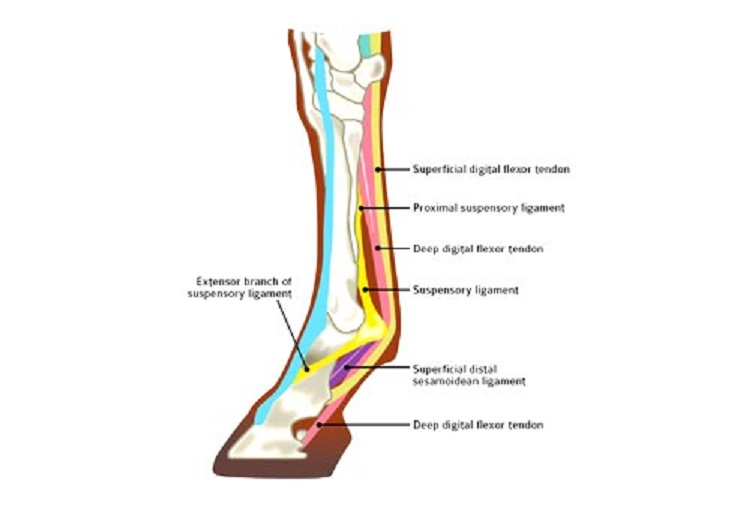 (suspensory-ligament-in-a-horses-leg 150.jpg) (suspensory-ligament-in-a-horses-leg 150.jpg)
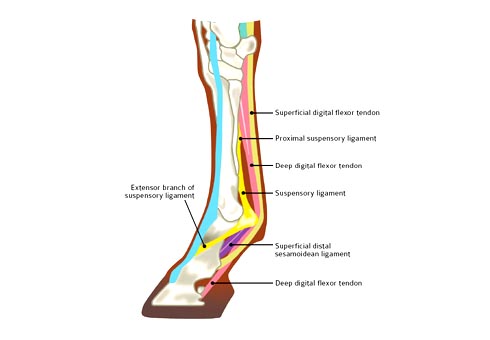 (suspensory-ligament-in-a-horses-leg.jpg) (suspensory-ligament-in-a-horses-leg.jpg)
Attachments
----------------
 suspensory-ligament-in-a-horses-leg 150.jpg (53KB - 225 downloads) suspensory-ligament-in-a-horses-leg 150.jpg (53KB - 225 downloads)
suspensory-ligament-in-a-horses-leg.jpg (28KB - 218 downloads)
|
|
| |
|
 Experienced Mouse Trapper
Posts: 3106

Location: North Dakota | If she has always worked the bit and is mouthy (to the point of distraction) #1 have her teeth looked at #2 bit her up for awhile so the feel of the bit in her mouth becomes normal (I sometimes put the bit in their mouth, put a halter over the headstall and tie them for a day or two just to get them comfortable with the bit) #3 if 1 and 2 do not work try a light hack/sidepull to see ifher attention is better. If it is better with the hack/sidepull I would definitely have her chiro'd. Focusing their attention on the job is sometimes very difficult for some young horses. |
|
| |
|
| BARRELHORSE USA - 2017-08-22 6:48 AM
I think you have answered your own problem.
Injured badly on the right rear....
has difficulty stepping to the right which requires her weight
to be mainly on that leg // hoof ...
When any of these suspensory ligaments are injured it
weakens the horses ability to keep the hoof in position
so it will land on the heel of the hoof.
Instead the weakened damaged ligament will allow the
hoof to flop downward and the horses hoof lands on the face
of the hoof wall...
(pretend the palm of your hand is the sole
of the hoof.. sit down.. now place the back of your hand on
your thigh with the wrist bent and palm facing upwards and
apply a little weight to it) The pain will let you know that
there is no support to this hoof to continue the stride.
Add weight of a rider and the injured ligament fails regardless
of the gait or backing up which is the tuffest thing for a horse
to do.
Your horse having a nervous mouth could be anticipation of
a sharp pain due to the above and a fear of moving forward.
Regardless what someone or vet tells you about one of these
permanently injured ligaments healing up and their
horse became a world champion.... their horse only had
a mild case of inflammation to one of these tendons or the
tendon sheath.
Keep an eye on all 4 feet for the floppy hoof to happen because
any one of them could have been injured in the wheelbarrow
incident or while horse was favoring the right rear... especially
if they were put on a long stall rest.
If you have access to a horse walker ..
Saddle her up for the weight and put her on it for an
hour or two at a walk and see what happens. Take another
set of eyes with you and watch for toe dragging prior to
having a misstep. If you blink you will miss the misstep!!
A hop in a step will tell you she recovered hoof enough to
land the toe of the sole of the hoof.
Don't get crazy on me and speed up the walker ... she is going
to go down at a faster gait or tear up the walker!!!
I know in your mind that you know this horse is too dangerous
to ride and all the kings men can't fix the problem.
It is time to make a decision on broodmare status and find
you something else to train.
GOOD LUCK ...
LIVING GIVES ONE SOME TUFF DECISIONS TO MAKE.
Yes, I know the photo is of a front leg because it was a good
looksee of same ligaments in the rear legs. LOL
As you can see... all of these ligaments lead to controlling anything
below the knee and lead to the hoof.
Well, she injured the front of the leg, not near the suspensory. Also, the vet's at A&M thought that maybe her suspensorys were causing the problem so we ultrasounded both and nothing came up.
Also in response to the post above - the vets at A&M said she blocked from the hock and below when they were doing the lameness exam on her.. so that is why they thought it was either suspensorys or hocks. I thought for sure it wasn't hocks (because I didn't understand how a 3 yo could have hock issues already) but when the suspensorys came back clean, that was pretty much my only option. I asked how a young horse can have issues and they said while uncommon, it is not impossible for them to just have it genetically.
As for her stifles, I do not notice any particular straightness in them, but I will go look at her and see. When examining her, no vet was able to find soreness there either. |
|
| |
|
| I had her teeth done in January (wolf teeth/bit seat/etc). I'm thinking more miles in the bit and maybe something with a roller. If that doesn't help I agree with going to something bitless. |
|
| |
|
Expert
Posts: 1599
| achildres - 2017-08-21 11:12 PM I am writing this with hopes that someone might have some insight on the problems we are having with a 3 yo filly of mine... So a little background, this filly was born and raised with me, so I have seen all of it with her. As a long yearling, she stepped into a metal wheelbarrow and cut up her legs (particularly her back right leg). She healed fine other than a good scar on that back leg. Other than that, she's had a very normal life. The fall of her 2 yo year, I sent her off to the trainer. After 3 months, he was basically unable to get her to lope because she just couldn't keep her balance. Fast forward to this spring (after she came home and was fattened up and healthy again), I started working her. I could only get her to lope for MAYBE a few strides and then she would break down to a trot again. All the while, she would trip just walking/trotting, etc. We had been working up more and more strides, and finally one day, I was trying to get her to catch her lead and it seemed like just when she was about to pick up her lead, she tripped and did a complete somersault. I brought her to the vet for a neuro eval.. and nothing out of the ordinary came up. We put shoes on her and I started up again a few weeks later. When she started riding again after that, she was still tripping all over herself... it was like she didn't know where her feet were. She would trip walking, trotting, and backing up (multiple times in one ride). I did not feel safe with this so I called a different vet for a different set of eyes on her. She thought maybe she had wobbler's, so we sent her to Texas A&M to get her evaluated by them. They were confident she does not have wobblers, and after a week of many many different vets looking at her and a large vet bill later, all they could find was that her hocks were showing soreness as were her front feet. So we put front shoes back on and injected the hocks. Today I just rode her again for the first time since all of this (its been about a month.... all we did was walk). There was no tripping today. But she still seems to be INCREDIBLY focused on the bit and not really where her feet are... It's like she focuses so hard on what is in her mouth that she doesn't think about her feet. She seems extremely agitated and has a hard time grasping the concept of turning to the right (it is much much better than it was before her trip to A&M though). I haven't given up hope yet, as I am just taking small victories with her each day.. but I am wondering if anyone out here has any insight on this.... I just can't seem to come to terms with it is "just sore hocks/front feet".. Disclaimer: this horse can run laps around the pasture full speed with no problem. But once a person gets on her it's hard to even get her to move forward... If she's passed on the neuro stuff she could just be incredibly lazy and not want to pick up her feet. What does she do in the round pen free lunging? Get a rope and make her move forward and learn to use her feet.
ETA:
Did the inject her without x-raying her?
Soreness in her front feet would def make her clumsy and not want to move forward!
Edited by lopnaround 2017-08-22 10:33 AM
|
|
| |
|
 Too Skinny
Posts: 8009

Location: LA Lower Alabama | I bought a yearling colt from a well named person through pictures and he arrived with some cuts on his leg that they blamed on the trailer ramp. Someone here noticed something off and it turns out he had ocd leisions so dont count on young ones being clean anywhere. Even if you raised them.
I would be very careful riding until you figure out what it is. Do you have any videos of them traveling with you on them?
|
|
| |
|
 Born not Made
Posts: 2937
Location: North Dakota | Did they x-ray her hocks?
It is possible for horses to be fusing that young to create soreness (ask me how I know...) but you did not mention that they did x-rays or that they figured out the SOURCE of the soreness.
Anyway, if this were my horse, I'd throw them back out in the pasture to mature for another year and see how they do next year. Just might not be ready at 3.
|
|
| |
|
 A Somebody to Everybody
Posts: 41354
Location: Under The Big Sky Of Texas | I would have her tested for EPM and if you did already have her tested I would retest her just to be really sure, and I would not be getting on her if she dont have the balance, doing the complete somersault would have me really worried about riding her. And why did you have to fatting her up and get her healthy again befor you started to ride her? Did she get sick? |
|
| |
|
 Expert
Posts: 2604
Location: Texas | Something else to consider... x-ray her back for kissing spine. Might be causing enough discomfort with a rider that she is unable to focus on where her feet are or is avoiding traveling correctly because of pain. |
|
| |
|
 Expert
Posts: 2097
Location: Deep South | achildres - 2017-08-22 9:01 AM
I had her teeth done in January (wolf teeth/bit seat/etc). I'm thinking more miles in the bit and maybe something with a roller. If that doesn't help I agree with going to something bitless.
8 months is typically too long to go in between dental appts for a 3yo. Their mouths are changing too quickly at that age. |
|
| |


 Folks on-line