|
|
 Elite Veteran
Posts: 1119
 
| Sorry, this is kind of long....wanting to see if anyone has experience dealing with anything like this!
Last Friday night (17th), I came home from work to find one of my geldings standing way off by himself. As I walked up to him, a rotting smell hit me from 6-8 feet away. The right side of his withers and shoulders were covered in pus/drainage and I could tell he was in a lot of pain. I led him up to the trailer and immediately scrubbing using Dawn dish soap and warm water to try and figure out what I was dealing with. It took quite a while for me to find what looks like an abscess right on top of his withers, in his mane.
I called the vet, he advised a tetanus shot, penicillan, and keeping the area clean and open so it could continue draining. He also mentioned fistulous withers. I followed his advice for Friday night and then researched that night. Called him back Saturday morning and talked more about fistulous withers. He wanted me to follow his protocol and call him back later this week (planning to call today). I'm hoping it's not fistulous withers. It can be contagious to humans and other horses if caused by the brucella bacteria, but it can also be a nightmare to treat and seems to have a high rate of reoccurence, even once you think it's gone. Since the abscess is on top of his withers, I'm afraid getting it to drain completely will be difficult.
Yesterday I was feeling really good about how he was doing. He had went from being in obvious pain Friday to acting like his normal self. Running in the roundpen and having quite a bit of energy. Today, I feel like he may be having a setback. He had noticeably less energy and wasn't overly interested in his hay this moring. He did eat his grain (I've been giving him grain + Bute 2x daily). I have been hosing the abscess twice each day to remove any pus and scabs that are forming, and then squirting some hydrogen peroxide on it. He is getting 20cc of penicillan (he only weighs in the 8-900 lb range), and then he's getting two dosages of Bute each day (maximum daily dosage, per directions on tub).
Does anyone have any advice or experience dealing with something like this? I'll try to attach some pictures of how it looks. He originally had some swelling in the left side of his withers, but that seems to be gone now.
Edited by MissouriJen 2017-03-27 10:07 AM
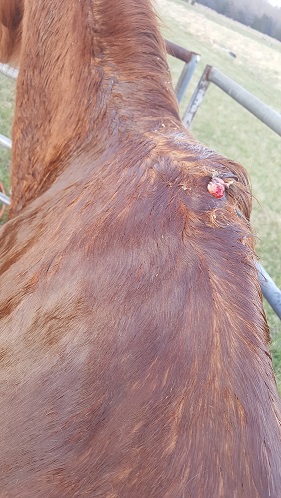 (2017-03-20 18.39.36.jpg) (2017-03-20 18.39.36.jpg)
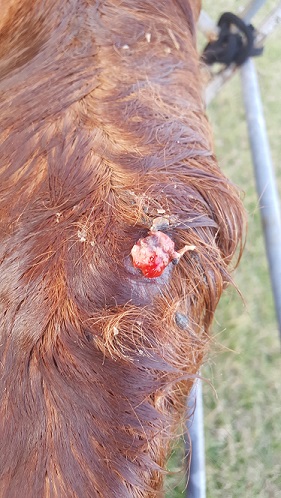 (2017-03-20 18.39.30.jpg) (2017-03-20 18.39.30.jpg)
Attachments
----------------
 2017-03-20 18.39.36.jpg (86KB - 969 downloads) 2017-03-20 18.39.36.jpg (86KB - 969 downloads)
2017-03-20 18.39.30.jpg (90KB - 227 downloads)
|
|
| |
|
 You get what you give
Posts: 13030
  
Location: Texas | I would be going into a vet and i would have that cultured. Do you have any referral hospitals or universities around you? |
|
| |
|
 A Somebody to Everybody
Posts: 41354
Location: Under The Big Sky Of Texas | MissouriJen - 2017-03-22 12:06 PM Sorry, this is kind of long....wanting to see if anyone has experience dealing with anything like this!
Last Friday night (17th), I came home from work to find one of my geldings standing way off by himself. As I walked up to him, a rotting smell hit me from 6-8 feet away. The right side of his withers and shoulders were covered in pus/drainage and I could tell he was in a lot of pain. I led him up to the trailer and immediately scrubbing using Dawn dish soap and warm water to try and figure out what I was dealing with. It took quite a while for me to find what looks like an abscess right on top of his withers, in his mane.
I called the vet, he advised a tetanus shot, penicillan, and keeping the area clean and open so it could continue draining. He also mentioned fistulous withers. I followed his advice for Friday night and then researched that night. Called him back Saturday morning and talked more about fistulous withers. He wanted me to follow his protocol and call him back later this week (planning to call today). I'm hoping it's not fistulous withers. It can be contagious to humans and other horses if caused by the brucella bacteria, but it can also be a nightmare to treat and seems to have a high rate of reoccurence, even once you think it's gone. Since the abscess is on top of his withers, I'm afraid getting it to drain completely will be difficult.
Yesterday I was feeling really good about how he was doing. He had went from being in obvious pain Friday to acting like his normal self. Running in the roundpen and having quite a bit of energy. Today, I feel like he may be having a setback. He had noticeably less energy and wasn't overly interested in his hay this moring. He did eat his grain (I've been giving him grain + Bute 2x daily). I have been hosing the abscess twice each day to remove any pus and scabs that are forming, and then squirting some hydrogen peroxide on it. He is getting 20cc of penicillan (he only weighs in the 8-900 lb range), and then he's getting two dosages of Bute each day (maximum daily dosage, per directions on tub).
Does anyone have any advice or experience dealing with something like this? I'll try to attach some pictures of how it looks. He originally had some swelling in the left side of his withers, but that seems to be gone now.
That looks really really bad, you really need to take this horse to a good vet, this is something that I would not be messing around with. |
|
| |
|
 Expert
Posts: 3815

Location: The best kept secret in TX | I agree with the above posts.
Also, HP eats away good and bad bacteria. I would be using a different cleaning solution such as Underwoods rather than HP.
TRAILER HIM TO A VET AND GET A CULTURE!!!
Oh, and hugs  |
|
| |
|
 Take a Picture
Posts: 12841
| We had a horse years ago that had fistula son her withers and up and down her neck. My dad took a bulb during and put iodine in it. They do get this from the brucellosis or bangs bacteria. I really thought that they had pretty much eliminated that in cattle anyway. If the horse bruised the area by running up under a low shed or rolling on a rock, the severe bruise could easily do this. I have not seen a real fistula on a horse in 40 years if that makes you feel any better. |
|
| |
|
 Expert
Posts: 1268
Location: North of Tulsa, Oklahoma | Any chance another horse reared up and pawed him?
Several years ago we had that happen to one (best we can figure) and it had actually knocked the caps off his vertebrae in his wither area. Went to vet thinking fistula, and x-rays showed the fractures. At the time they were in place and we chose to wait and see. 6 months later he required minor surgery to remove the shards/slivers that had reattached on the side and formed protective fat globules and abcesses around them. Simple standing surgery and he healed fine and was rideable, just mutton withered.
Edited by RoanyGoodPoni 2017-03-22 8:53 PM
|
|
| |
|
  Warmblood with Wings
Posts: 27846
Location: Florida.. | Id be taking him in to.. |
|
| |
|
Tried and True
Posts: 21185
Location: Where I am happiest | Do not use hydrogen peroxide. Wash with a good surgical scrub. I'd also be getting him in to a good vet asap. |
|
| |
|
Expert
Posts: 3815
Location: The best kept secret in TX | OP do you have any update for us?
Hopefully you've stopped use of the Hydrogen Peroxide at least. |
|
| |
|
 Half-Eaten Cookies
Posts: 2076
Location: Fort Worth / Springtown | Either what Roany said about rearing from another horse, that or what about saddle fit? Seems like 800-900 lbs with that high of a wither (from the pics) I hope the saddle wouldn't be causing it (too low on the spine).
I had a horse with something similar but on the side...I can't rember a lot of details, but at first it was thought it could be fistulous withers- it was about 18 years ago and my dad mostly spoke to vet.
As it began to heal, it began to move forward a little, out from under where the saddle was....and I began riding him again with the vet's perimisson, because it had formed a "grisel" over it, and did not show pain.
We never knew the sure cause.
Edited by txbredbr 2017-03-23 10:05 AM
|
|
| |
|
Elite Veteran
Posts: 1119
| Thanks for all the input! I have stopped the hydrogen peroxide - that had been a recommendation from a Facebook friend. I've been hesitant to use anything like Underwoods (even though I typically use that for everything), because I didn't want to put anything on it that would "plug it up," so to speak.
I've got a few calls in to different vets and have sent pictures so they have an idea of what it looks like. He is an extremely narrow horse (he's a Tennessee Walker), with high withers. I haven't ridden him since last fall, so it wasn't caused by saddle fit issues, but he is constantly getting into trouble. Two days after I bought him he fell through the ice on the pond and it's been one crazy thing after another with him. As far as I know, he's never been around cattle, so I don't think he contracted brucellosis. My guess is that he rubbed on a tree or a fence and punctured himself. He's also the head honcho of my herd and always bickering with the other geldings, so it's possible one of them bit him or something along those lines. I'm hoping to get him into the vet in the next couple of days to get him checked out. He's definitely acting like his normal self, but it's still draining quite a bit so it's hard for me to know if it's healing or not. |
|
| |
|
 I Don't Brag
Posts: 6960
| Don't forget to give him pre/probiotics at least an hour after antibiotics. You are again killing off the good bacteria with the bad and may explain why he is acting puny. |
|
| |
|
The Advice Guru
Posts: 6419
| My vet would say that 20 cc of penicillin is going to contribute to more problems and more antibiotic resistant organisms as the dose is ineffective.
My vet always gets me to give 60 cc twice a day for 3 days as this will get the blood levels up. Then he gets me to give 30cc twice a day for minimum of 7 days.
The half life of penicillin is 12 hours so by giving it every 24 hours you are not getting the blood levels up.
The long acting penicillin if you can even find it, I was allowed to start using that at day 5 |
|
| |
|
 Lived to tell about it and will never do it again
Posts: 5409
| Had a horse with this years ago. Pretty sure it was caused from rolling on a rock. His had to be cut out and it never did heal up. After awhile we were able to ride him again. He was a heading, heeling and barrel horse. After it was cut out the best thing that Mom found that worked on it was Cut N Heal. We would clean it out everyday and put that on it. Sometimes we just used a powder of some kind. He died about 6 years later from an unrelated thing with the hole still there. |
|
| |
|
 Shelter Dog Lover
Posts: 10277
| I appreciate that you're trying to help him but this is something that could develop into a very serious situation. If you have the capability I would get him to a vet. It is usually cheaper in the long run to get it treated correctly from the beginning. |
|
| |
|
Warmblood with Wings
Posts: 27846
Location: Florida.. | if it keeps opening there could be a piece of branch splinter in there , maybe he rubbed on a tree |
|
| |
|
Elite Veteran
Posts: 1119
| I have an appointment this afternoon with a (different) equine vet. They were in agreement with everything that had been done so far, but would have used a different antibiotic. Starting with an exam and a culture, but hopefully I'll have some more answers later today! |
|
| |
|
 Elite Veteran
Posts: 929
| HAVE IT X-RAYED!!!! This scares me... A LOT!!! Some history: I had a horse with what we thought was a fistula. Turns out it was what is called Degenerative Bone Disease. We treated for fistula but other spots started emerging, turns out it was portions of the wither bones that had decayed and were abscessing up through the back.
To make a long story short, we took the horse to surgery where the vet cut out the necrotic bone. Took about 6 months to heal...just to find that parts of the scapula were also starting to decay.
I hope this is not what's happening to your horse, but please get him x-rayed rather than spend a bunch for lots of treatments. Yes, the rads are an up front expense, but you can save yourself a lot of time, money, and heartache if you eliminate this from the equation first.
(My advice- if it is the bone disease, do NOT let your vet and equine surgeon talk you into surgery. It was hard on the horse and the "open wound" was HORRIFIC. And I was a veterinary technician at the time, so you know it was bad.)
Good luck to you and your horse. I will be praying that your situation is not the same as mine was. |
|
| |
|
Elite Veteran
Posts: 1119
| Update: Took Finn to the vet on Friday. They did several x-rays and a very thorough exam. Diagnosis is that all signs point to fistulous withers. They gave me a small tube and betadine to flush the wound out with 2x daily. Once the cultures come back and we know what type of bacteria we may be dealing with, will likely start him on another round of antibiotics. Hopefully should know by Wednesday. He will definitely need surgery, and often more than one are needed to get out all of the infected tissue.
It's believed to have been caused by a trauma, although I have no idea what he did. The surgeon thought, IF we can get him healed, that he will be able to be ridden again. I'm counting him out for this year though. |
|
| |
|
Veteran
Posts: 279
Location: Louisiana | I have treated 3 different horses with this many years ago. A pony and two horses and not all of them belonged to us. We actually bought one of the horses for $150 because of the injury. All were due to some type of injury, bite from another horse, bruise, etc. I flushed out the wound with a diluted solution of pure lysol twice a day to keep it draining. Since it was so long ago, I don't remember if antibotics were given. I doubt it. We put an ointment to keep flies off and help healing. Cured all three with only s small scar. This is just what we did and it worked for us, many, many years ago. I know things have changed and new methods discovered. |
|
| |


 Folks on-line