|
|
Veteran
Posts: 155
 
Location: Riding or working in Texas | Cellulitis !!! Ugh what do I put on the wound and wrap or don't wrap?? She has already had antibiotics and I'm giving bute for swelling. Hydro twice a day with exercise but I have struggled with wether I should wrap or not and what meds to put on this ugly thing. ????
I will try and add a picture ! |
|
| |
|
 Hummer's Hero
Posts: 3071
 
Location: Smack Dab in the Middle | I used a DMSO/Tetracyclene mixture that my vet provided. Salve and gauze on the wound, drench on the leg and wrapped it with cast pad and vetwrap. |
|
| |
|
Veteran
Posts: 155
Location: Riding or working in Texas | Not sure how to make my pic small enough on my cell phone pic coming soon as I get home :/ |
|
| |
|
 My Heart Be Happy
Posts: 9159

Location: Arkansas | Bump |
|
| |
|
 Veteran
Posts: 158
| Ask your vet do give dmso IV, you will have a horse that smells but it works |
|
| |
|
 BHW Resident Surgeon
Posts: 25352
Location: Bastrop, Texas | Turninhard - 2017-04-11 12:11 PM
Cellulitis !!! Ugh what do I put on the wound and wrap or don't wrap?? She has already had antibiotics and I'm giving bute for swelling. Hydro twice a day with exercise but I have struggled with wether I should wrap or not and what meds to put on this ugly thing. ????
I will try and add a picture !
Where is the cellulitis located? Why are you calling it cellulitis? How long has it been there? How did it get there.....ie: cut, abrasion, bruise, etc...? |
|
| |
|
  Angel in a Sorrel Coat
Posts: 16030
Location: In a happy place | When my stud got cellulitis both his back legs were as big around as a stove pipe. Cellulitis is nothing to play around with. My vet kept him at his clinic for over a week. It is quite painful.....my stud was very stoic but he was quite painful at that time and it showed. And I can tell you, as I have cellulitis right now it is most painful. I would strongly suggest you get to the vet and make sure this is what your horse has. |
|
| |
|
Veteran
Posts: 155
Location: Riding or working in Texas | Here is a picture of her ankle. I have spoke with my vet he said yes it is indeed a cellulitis we have given her antibiotics orally and bute for pain, swelling hasn't been to bad. I have been doctoring her leg sense November there was a different conversation about wrapping her leg and such. I believe that the entry point for the cellulitis was from her previous injury that was almost healed. i feel so deflated to be battling this after her leg injury!! I do also have an appointment for her to be seen again. I cold water treat her twice a day so i see every little change in her.
I just wasn't sure what to put on the actual cellulitis??
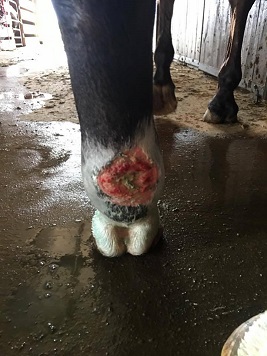 (grace.jpg) (grace.jpg)
Attachments
----------------
 grace.jpg (44KB - 190 downloads) grace.jpg (44KB - 190 downloads)
|
|
| |
|
Veteran
Posts: 155
Location: Riding or working in Texas | this was the initial injury i have been rehabbing and she was doing great!
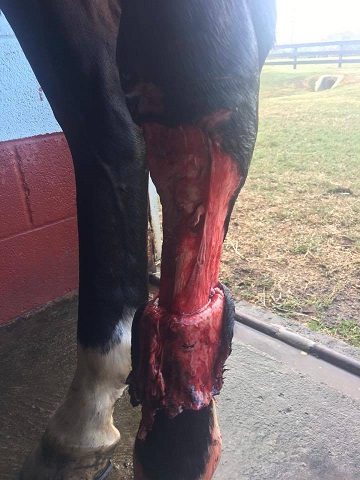 (17918092_10211019794643440_1159599491_n.jpg) (17918092_10211019794643440_1159599491_n.jpg)
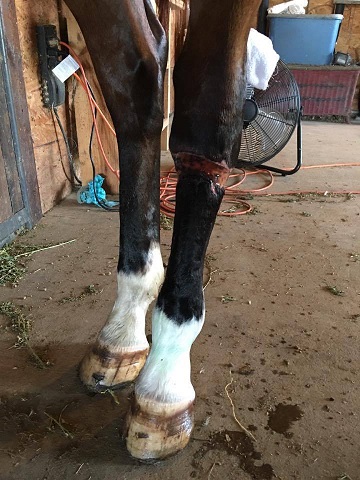 (17909375_10211019783323157_1108875194_n.jpg) (17909375_10211019783323157_1108875194_n.jpg)
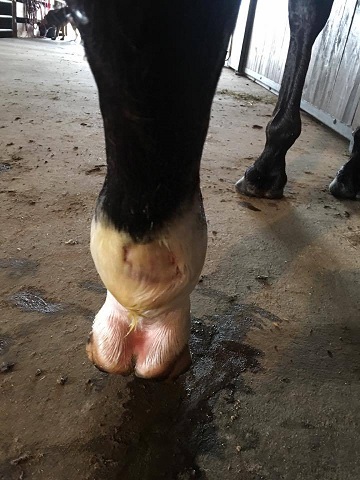 (17909468_10211019785123202_1073938199_n.jpg) (17909468_10211019785123202_1073938199_n.jpg)
Attachments
----------------
17918092_10211019794643440_1159599491_n.jpg (70KB - 214 downloads)
17909375_10211019783323157_1108875194_n.jpg (86KB - 213 downloads)
17909468_10211019785123202_1073938199_n.jpg (74KB - 188 downloads)
|
|
| |
|
BHW Resident Surgeon
Posts: 25352
Location: Bastrop, Texas | So it looks like a "de-gloving" injury there, and that has all healed except for that granulating wound behind the fetlock. That kind of injury can interrupt the lymphatic drainage and basically cause lymphedema in the lower leg. I can't say that's what's going on here, but that's a strong possibility. It looks to me like this wound is quite a bit worse.
I assume the first picture you posted of the open, beefy red wound, is the most recent photo. In the center of that wound is some green, dead tissue. If lymphedema is playing a role here, then my guess is that he needs to have that wound sharply debrided of all that dead tissue, and some form of mild elastic compression would help reduce the lymphedema. You'd need sedation to sharply debrided this, most likely. I'd wash and scrub that wound with a surgical soap, apply a layer of 4X4s, and wrap it. Antibiotic might help in this instance, if there's lymphedema. I'd do this twice a day, ideally. I know it's a lot of work, but if I had to guess that's what I think would work well. |
|
| |
|
Veteran
Posts: 155
Location: Riding or working in Texas | thank you Bear,
yes the degloving injury is the injury that happened in november and there was no issue or "injury" to the ankle at the time her leg has been healing and i have managed to get it looking pretty good and finally could get away with out wrapping and minimal swelling. then about a week ago i noticed the round blotching on her lower ankle and even some slightly in the front of her ankle. immediatly started her on antibiotics and emmense cleaning of the leg which was already happening i just stepped up the cleaning. swelling has not been to bad but is present. i do have her another appointment . I just wanted to know if anyone had delt with this and what they had done to help or what the standard was to wrap or not to what cream or not .. that kind of stuff? |
|
| |
|
 Expert
Posts: 3815

Location: The best kept secret in TX | Mine had a de-gloving type wound on the front of his hock. I scrubbed the area really well with betadine surgical scrub, cold hosed, let air dry, then added fura zone per vet orders. I put a layer of non stick gauze over the fura zone. I added a layer of cotton padding over the wound. I wrapped all of this with vet wrap, leaving an opening for his hock to be able to bend and then taped the vet wrap to the top and bottom of his leg with elastic bandage tape. I did this for about 6 months while new skin was growing. Vet was please with minimal scaring, no further infection, and full range of motion without any permanet damage to nerves or tissue.
Edited by IRunOnFaith 2017-04-12 2:19 PM
|
|
| |
|
BHW Resident Surgeon
Posts: 25352
Location: Bastrop, Texas | IRunOnFaith - 2017-04-12 2:17 PM
Mine had a de-gloving type wound on the front of his hock. I scrubbed the area really well with betadine surgical scrub, cold hosed, let air dry, then added fura zone per vet orders. I put a layer of non stick gauze over the fura zone. I added a layer of cotton padding over the wound. I wrapped all of this with vet wrap, leaving an opening for his hock to be able to bend and then taped the vet wrap to the top and bottom of his leg with elastic bandage tape. I did this for about 6 months while new skin was growing. Vet was please with minimal scaring, no further infection, and full range of motion without any permanet damage to nerves or tissue.
Excellent job. This is what I was talking about basically.
If this horse has lymphedema, then he'll always be prone to infections below the scarring. The OP did a great job with the original wound, but with the healing came scarring, and this ulcer popped up out of nowhere. Normally, I don't think treating the swelling, per se', is all that important, but with lymphedema, that's a whole different ballgame. I bet that's what's going on here. |
|
| |
|
Expert
Posts: 3815
Location: The best kept secret in TX | Bear - 2017-04-12 2:28 PM IRunOnFaith - 2017-04-12 2:17 PM Mine had a de-gloving type wound on the front of his hock. I scrubbed the area really well with betadine surgical scrub, cold hosed, let air dry, then added fura zone per vet orders. I put a layer of non stick gauze over the fura zone. I added a layer of cotton padding over the wound. I wrapped all of this with vet wrap, leaving an opening for his hock to be able to bend and then taped the vet wrap to the top and bottom of his leg with elastic bandage tape. I did this for about 6 months while new skin was growing. Vet was please with minimal scaring, no further infection, and full range of motion without any permanet damage to nerves or tissue. Excellent job. This is what I was talking about basically. If this horse has lymphedema, then he'll always be prone to infections below the scarring. The OP did a great job with the original wound, but with the healing came scarring, and this ulcer popped up out of nowhere. Normally, I don't think treating the swelling, per se', is all that important, but with lymphedema, that's a whole different ballgame. I bet that's what's going on here.
Bear, I am not familiar with the term hilighted. Could you elaborate?
What is the main difference in the OPs case and my case? Does treatment differ in the two cases or can she follow the procedure I used to treat? Does healing differ in the two cases?  |
|
| |


 Folks on-line