|
|
 Expert
Posts: 2457
  
| TurnLane - 2015-05-14 4:15 PM Are you a vet student or vet tech? I am enjoying this conversation. 
Neither - I am livestock virus/vector researcher by day.
My undergrad years were spent in Microbiology and Animal Nutrition before I received my MS in Vet Pathobiology - My Dad was a livestock nutritionist for Mana Pro and later Foster Farms (producing chickens) before he retired. He instilled a joy for all things science and taught me to read information wtih a critical, yet open and objective, mind.
Glad to help as much as I can - if I don't know something my job is to figure it out and learn soooooo that has rolled into my personal life, horses, livestock, dogs, future husband ... (j/k). |
|
| |
|
Expert
Posts: 2457
| astreakinchic - 2015-05-14 12:57 PM On all the hind gut stuff. I had a holistic vet/chiro guy tell me that only certain kinds of probiotics will work for a horse because they are not live cultures. He sold/pushed probi which must be refrigerated once opened and is super expensive $262.47 a gallon! I know some cutters/reiners that are just crazy about it. Also, it has a big following in FL where this vet resides. I thought it was all bull. Once you put bacteria cultures into the stomach they should in theory grow just like they would on stomach pH simulated nutrient agar. I don't wanna an extremely stressed out horse's stomach pH would just kill all of the cultures you were feeding them. I worked in the microbiology lab during undergrad and took samples of forco and probios in to be located at just out of crusty because she let us culture anything we wanted, even poop LOL It wasn't a super scientific study I was a freshman in college, anyways both grew out just fine. I wanted to test the effectiveness of these at different pH's but my senior seminar professional persuaded me to go more wildlife conservationist to my area so i'd have something to talk about if I wanted to interview for a conservationist job. Wish Sometimes I wonder if regular plain yogurt and yeast culture that you buy in bulk for whole foods wouldn't do the job just as well. Long ago they used to tell you to feed your horse plain vanilla yogurt after stressful injuries or surgery. I'd like to try this DSI supplement, but sometimes I wonder...
We routinely use plain old vanilla yogurt to restart lamb gut flora after they've been sick! It works really really well!
And, your post made me giggle ... last summer my student intern had some fungus on her horse that we brought in the lab. We cultured, stained, and ID'd it too! |
|
| |
|
Expert
Posts: 1611
 
| lindseylou2290 - 2015-05-14 9:39 PM
astreakinchic - 2015-05-14 12:57 PM On all the hind gut stuff. I had a holistic vet/chiro guy tell me that only certain kinds of probiotics will work for a horse because they are not live cultures. He sold/pushed probi which must be refrigerated once opened and is super expensive $262.47 a gallon! I know some cutters/reiners that are just crazy about it. Also, it has a big following in FL where this vet resides. I thought it was all bull. Once you put bacteria cultures into the stomach they should in theory grow just like they would on stomach pH simulated nutrient agar. I don't wanna an extremely stressed out horse's stomach pH would just kill all of the cultures you were feeding them. I worked in the microbiology lab during undergrad and took samples of forco and probios in to be located at just out of crusty because she let us culture anything we wanted, even poop LOL It wasn't a super scientific study I was a freshman in college, anyways both grew out just fine. I wanted to test the effectiveness of these at different pH's but my senior seminar professional persuaded me to go more wildlife conservationist to my area so i'd have something to talk about if I wanted to interview for a conservationist job. Wish Sometimes I wonder if regular plain yogurt and yeast culture that you buy in bulk for whole foods wouldn't do the job just as well. Long ago they used to tell you to feed your horse plain vanilla yogurt after stressful injuries or surgery. I'd like to try this DSI supplement, but sometimes I wonder...
We routinely use plain old vanilla yogurt to restart lamb gut flora after they've been sick! It works really really well!
And, your post made me giggle ... last summer my student intern had some fungus on her horse that we brought in the lab. We cultured, stained, and ID'd it too!
GAH!!! You have my dream job!!!
Lord reading over my post my phone massacred what I was really saying but I think you deciphered it LOL Thank you for sharing all your info! I agree with an above poster good info on this thread. Also if your sneaky you can continue to use the pub med database even after graduating from college if your college doesn't take your email login for it away.
Edited by astreakinchic 2015-05-15 7:59 AM
|
|
| |
|
Expert
Posts: 2457
| astreakinchic - 2015-05-15 7:39 AM
lindseylou2290 - 2015-05-14 9:39 PM
astreakinchic - 2015-05-14 12:57 PM On all the hind gut stuff. I had a holistic vet/chiro guy tell me that only certain kinds of probiotics will work for a horse because they are not live cultures. He sold/pushed probi which must be refrigerated once opened and is super expensive $262.47 a gallon! I know some cutters/reiners that are just crazy about it. Also, it has a big following in FL where this vet resides. I thought it was all bull. Once you put bacteria cultures into the stomach they should in theory grow just like they would on stomach pH simulated nutrient agar. I don't wanna an extremely stressed out horse's stomach pH would just kill all of the cultures you were feeding them. I worked in the microbiology lab during undergrad and took samples of forco and probios in to be located at just out of crusty because she let us culture anything we wanted, even poop LOL It wasn't a super scientific study I was a freshman in college, anyways both grew out just fine. I wanted to test the effectiveness of these at different pH's but my senior seminar professional persuaded me to go more wildlife conservationist to my area so i'd have something to talk about if I wanted to interview for a conservationist job. Wish Sometimes I wonder if regular plain yogurt and yeast culture that you buy in bulk for whole foods wouldn't do the job just as well. Long ago they used to tell you to feed your horse plain vanilla yogurt after stressful injuries or surgery. I'd like to try this DSI supplement, but sometimes I wonder...
We routinely use plain old vanilla yogurt to restart lamb gut flora after they've been sick! It works really really well!
And, your post made me giggle ... last summer my student intern had some fungus on her horse that we brought in the lab. We cultured, stained, and ID'd it too!
GAH!!! You have my dream job!!!
Lord reading over my post my phone massacred what I was really saying but I think you deciphered it LOL Thank you for sharing all your info! I agree with an above poster good info on this thread. Also if your sneaky you can continue to use the pub med database even after graduating from college if your college doesn't take your email login for it away.
YES YOU CAN!!!
I used mine for 4 years before they finally cut me off. |
|
| |
|
 Pork Fat is my Favorite
Posts: 3791
Location: The Oklahoma plains. | Have you heard of Dr Flocks? I guess he is a sought after nutrition physiology type guy for Tyson ect?
Anyhow, he was telling me he preferred paste probiotic items over the dry stating that they freeze dry and hope for 25% viable bugs and it is actually like 5% yield. Kind of like your yogurt experience above.
He was speaking in simple terms so I could keep up so dont bash me for trying to repeat-lol. But he also said I only needed to use them short term not long term.
I am just looking for an item like RG to treat a burnt up hind gut. There are too many choices.
|
|
| |
|
Blessed 

Location: Here | lindseylou2290 - 2015-05-14 8:37 PM
TurnLane - 2015-05-14 4:15 PM Are you a vet student or vet tech? I am enjoying this conversation.
My undergrad years were spent in Microbiology and Animal Nutrition before I received my MS in Vet Pathobiology - My Dad was a livestock nutritionist for Mana Pro and later Foster Farms (producing chickens) before he retired. He instilled a joy for all things science and taught me to read information wtih a critical, yet open and objective, mind.
Glad to help as much as I can - if I don't know something my job is to figure it out and learn soooooo that has rolled into my personal life, horses, livestock, dogs, future husband ... (j/k).
 |
|
| |
|
 Jr. Detective
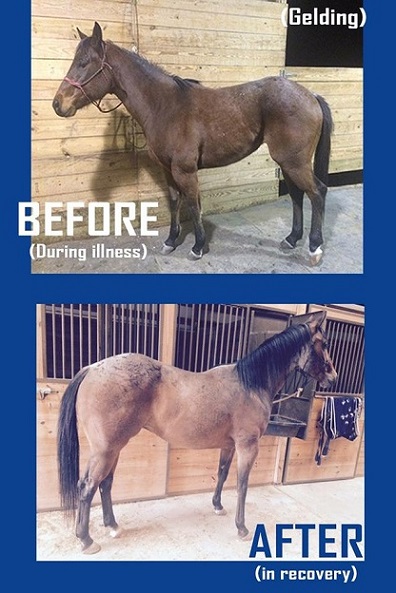
Location: Beggs, OK | rachellyn80 - 2015-05-13 1:58 PM The back story on these horses is a long and ongoing issue with the mill, so we will skip that part and just show you what we've been able to accomplish this far. My horses have not looked right for a couple of years now...So the excuse that this is the normal April/May spring bloom from green grass is not applicable in any way. The vets that have been caring for them have told me that they looked fine and I couldn't expect them to gain much for what they've been through. I couldn't accept that as an answer so I continued my research and contacted Bluebonnet to see what they recommended as they seemed like the safest feed that would be available to me. I was told to put them on Bluebonnet Intensify Omega Force. They are getting 6# a day and 4oz a day of Bluebonnet Transform DSI as well as Bluebonnet Element Minerals free choice and grass hay and alfalfa. The results have been amazing.
This is Jones. Jones was my sickest horse. He's a five year old previously easy keeper and the top picture is when he was sick. The bottom picture is as he was recovering. I wanted to add one more picture just so that you can see what Jones looked like before he got sick....he's still not there and it doesn't matter because we won't be able to use him, but it makes me sick to see what this has done to him.
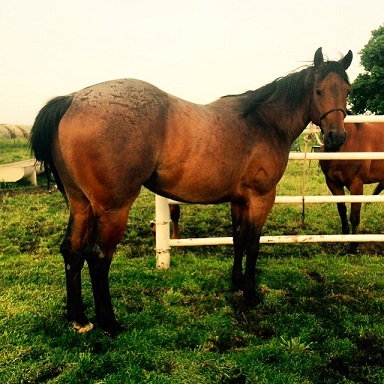
Here's an updated picture of Jones. This was taken last Friday. We are still having to bandage his back legs until they heal completely, but his body condition is amazing.
 (Jones Before & After.jpg) (Jones Before & After.jpg)
 (Jones May 15.jpg) (Jones May 15.jpg)
Attachments
----------------
 Jones Before & After.jpg (95KB - 183 downloads) Jones Before & After.jpg (95KB - 183 downloads)
Jones May 15.jpg (78KB - 195 downloads)
|
|
| |
|
  Whack and Roll
Posts: 6342
Location: NE Texas | Wow, that's pretty incredible! He looks fantastic, that is for sure! I too have been so thrilled with the Bluebonnet feed and the improvements in my horses that are just on the feed alone. Thank you for sharing your story with us! |
|
| |
|
Jr. Detective
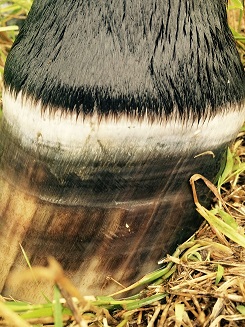
Location: Beggs, OK | This is a picture of one of that horse's front feet. The fever rings are so deep that you can see them. All of my horses have them since the feed change.
 (Jones Hoof May 15.jpg) (Jones Hoof May 15.jpg)
Attachments
----------------
Jones Hoof May 15.jpg (59KB - 187 downloads)
|
|
| |
|
Expert
Posts: 2457
| TurnLane - 2015-05-15 4:00 PM Have you heard of Dr Flocks? I guess he is a sought after nutrition physiology type guy for Tyson ect?
Anyhow, he was telling me he preferred paste probiotic items over the dry stating that they freeze dry and hope for 25% viable bugs and it is actually like 5% yield. Kind of like your yogurt experience above.
He was speaking in simple terms so I could keep up so dont bash me for trying to repeat-lol. But he also said I only needed to use them short term not long term.
I am just looking for an item like RG to treat a burnt up hind gut. There are too many choices.
Hmmm I don't know him.
I think one of things to keep in mind is what type of gut you're trying to feed or restart ....ie - what part are you repopulating and are you populating it with similar cultures to what was there originally. Some of these cultures are ubiquitous in livestock, some are most definately not.
With lambs we are targeting the Rumen usually as this is where most of the digestion happens in ruminant animals - absobtion happens further on in the gut (the intestines).
Horses are way different - they ferment and absorb in their intestines at the same time. Their stomachs are giant holding tubs with minimal digestion when compared to the rest of their system. If we are feeding live cultures, one difficulty in horses is getting that flora to survive the stomach and actually make it to the hind gut where it will be most useful. This also takes TIME and is not an overnight occurance. Thus, pelleted cultures were born in the industry.
There are some seriously GREAT supplements out there that are designed to feed through and accomplish just that!
ETA - He is correct in that once you repopulate the gut (and don't kill it again) you will not need to use them long term
Edited by lindseylou2290 2015-05-21 2:55 PM
|
|
| |
|
Blessed
Location: Here | rachellyn80 - 2015-05-21 12:31 PM This is a picture of one of that horse's front feet. The fever rings are so deep that you can see them. All of my horses have them since the feed change.
This is just  |
|
| |
|
Expert
Posts: 2457
| SG. - 2015-05-21 2:57 PM rachellyn80 - 2015-05-21 12:31 PM This is a picture of one of that horse's front feet. The fever rings are so deep that you can see them. All of my horses have them since the feed change. This is just
It makes me cringe thinking about it - youch!! |
|
| |
|
Blessed
Location: Here | lindseylou2290 - 2015-05-21 2:54 PM
Hmmm I don't know him.
I think one of things to keep in mind is what type of gut you're trying to feed or restart ....ie - what part are you repopulating and are you populating it with similar cultures to what was there originally. Some of these cultures are ubiquitous in livestock, some are most definately not.
With lambs we are targeting the Rumen usually as this is where most of the digestion happens in ruminant animals - absobtion happens further on in the gut (the intestines).
Horses are way different - they ferment and absorb in their intestines at the same time. Their stomachs are giant holding tubs with minimal digestion when compared to the rest of their system. If we are feeding live cultures, one difficulty in horses is getting that flora to survive the stomach and actually make it to the hind gut where it will be most useful. This also takes TIME and is not an overnight occurance. Thus, pelleted cultures were born in the industry.
There are some seriously GREAT supplements out there that are designed to feed through and accomplish just that!
ETA - He is correct in that once you repopulate the gut (and don't kill it again) you will not need to use them long term
Great info! Thank you for sharing this |
|
| |


 Folks on-line