|
|
 Hugs to You
Posts: 7551
   
Location: In The Land of Cotton | https://thehorse.com/171691/cargill-recalling-select-southern-states-horse-livestock-feed/?fbclid=IwAR084o5nef9e73Vxf6zZnwVLZyRChJJLoPM4JYmCD3SmOMg444VJV9CLrmg | |
| | |
 My Heart Be Happy
Posts: 9159

Location: Arkansas | Thanks for posting | |
| | |
 A Somebody to Everybody
Posts: 41354

Location: Under The Big Sky Of Texas | so scary  | |
| | |
Expert
Posts: 1695
Location: Willows, CA | I feel that the aflatoxin issue is the most overlooked problem in the feed industry. Recient studies out of Australia have shown amazing changes in horses that have had chronic high aflatoxin exposure when treated with a toxin binder. There are some new things coming to the US shortly as a result of those studies. The feed industry in general is not proactive enough on this issue. A lot of grains are used as feed ingredients because they do not meet human food grade standards and could not be sold into the human use market. The finished feeds that are least cost formulated may use the worst of these ingredients. Cattle seem to tolerate aflatoxins better than horses, and in many cases, feed companies do not seperate ingredients by species useage. | |
| | |
 Warrior Mom
Posts: 4400
| So I just discovered that cargill is who makes the rb I've been feeding , Progressive nutrition.. :-/ I wonder if they are considered a safe feed company?? Ugh, my horses seem to be very happy with it, idk.. they didn't like the TC RB so what's next | |
| | |
Extreme Veteran
Posts: 364
| Aflatoxins - Moldy grain. Wow that's terrible. | |
| | |
Married to a Louie Lover
Posts: 3303
| Aflatoxin in feed is tricky - as is any inbound grain quality issue. I work at a corn processor, for context. When we sample a 1,000bu truck, you end up with a small composite sample, maybe enough total to fill a gallon jug. That sample gets split. 3-4 dozen kernels may go into the aflo test. If it glows under a black light it goes to the next stage of testing for ppb and then acceptance or rejection is judged. It is possible for a bin of corn to have “spots” in it with high aflo and spots that are fine. It is possible for it to grow as corn is stored if conditions are right. It is possible that therefore that corn in one area of the truck have alfotoxin and corn in another area doesn’t. If you’re dealing with dishonest folks and they know they have a problem bin - that problem bin gets loaded on the bottom of the truck where the probe is less likely to catch it. It sucks and if we find out they’re doing it we have in the past told them they aren’t welcome at our facility any longer. Also realize that corn can have aflotoxins outside of the acceptable range and look like good corn to the naked eye, it is a mold but for it to be visible to the naked eye you have to have a very very serious problem. Sometimes it travels hand in hand with other quality issues, such as damage and fines - but not always, and the presence of damage and fines does not always indicate an aflotoxins issue. We spend a great deal of time each fall putting together samples and testing throughout our draw territory so we know if a particular has a problem, but again - those sample represent an incredibly small sample of the total production. We know what conditions tend to favor toxin development and do everything we can identify problem areas. I’m not defending the fact that a product with specs outside of tolerable ranges made it onto consumer shelves and into feed bunks - but I wanted to clarify that when you’re talking about alfotoxins and vomatoxins it’s not like the processor is taking in green, fuzzy moldy junk corn. | |
| | |
Expert
Posts: 1695
Location: Willows, CA | OhMax - 2019-05-12 9:31 AM Aflatoxin in feed is tricky - as is any inbound grain quality issue. I work at a corn processor, for context. When we sample a 1,000bu truck, you end up with a small composite sample, maybe enough total to fill a gallon jug. That sample gets split. 3-4 dozen kernels may go into the aflo test. If it glows under a black light it goes to the next stage of testing for ppb and then acceptance or rejection is judged. It is possible for a bin of corn to have “spots” in it with high aflo and spots that are fine. It is possible for it to grow as corn is stored if conditions are right. It is possible that therefore that corn in one area of the truck have alfotoxin and corn in another area doesn’t. If you’re dealing with dishonest folks and they know they have a problem bin - that problem bin gets loaded on the bottom of the truck where the probe is less likely to catch it. It sucks and if we find out they’re doing it we have in the past told them they aren’t welcome at our facility any longer. Also realize that corn can have aflotoxins outside of the acceptable range and look like good corn to the naked eye, it is a mold but for it to be visible to the naked eye you have to have a very very serious problem. Sometimes it travels hand in hand with other quality issues, such as damage and fines - but not always, and the presence of damage and fines does not always indicate an aflotoxins issue. We spend a great deal of time each fall putting together samples and testing throughout our draw territory so we know if a particular has a problem, but again - those sample represent an incredibly small sample of the total production. We know what conditions tend to favor toxin development and do everything we can identify problem areas. I’m not defending the fact that a product with specs outside of tolerable ranges made it onto consumer shelves and into feed bunks - but I wanted to clarify that when you’re talking about alfotoxins and vomatoxins it’s not like the processor is taking in green, fuzzy moldy junk corn. Years ago the corn industry negotiated a much higher allowable aflatoxin level for corn than any other grain. If I recall It used to be ten times the standard allowed for other grains, 300ppm vs 30ppm. . I assume that this is still the case. Most know that I am not a fan of corn being fed to horses in any significant amounts. My primary concern has always been the potential starch overload,and hind gut disruption, but this has been an issue also.
Edited by winwillows 2019-05-13 4:57 PM
| |
| | |
Married to a Louie Lover
Posts: 3303
| winwillows - 2019-05-13 4:54 PM
OhMax - 2019-05-12 9:31 AM
Aflatoxin in feed is tricky - as is any inbound grain quality issue. I work at a corn processor, for context.
When we sample a 1,000bu truck, you end up with a small composite sample, maybe enough total to fill a gallon jug. That sample gets split. 3-4 dozen kernels may go into the aflo test. If it glows under a black light it goes to the next stage of testing for ppb and then acceptance or rejection is judged.
It is possible for a bin of corn to have “spots” in it with high aflo and spots that are fine. It is possible for it to grow as corn is stored if conditions are right. It is possible that therefore that corn in one area of the truck have alfotoxin and corn in another area doesn’t. If you’re dealing with dishonest folks and they know they have a problem bin - that problem bin gets loaded on the bottom of the truck where the probe is less likely to catch it. It sucks and if we find out they’re doing it we have in the past told them they aren’t welcome at our facility any longer.
Also realize that corn can have aflotoxins outside of the acceptable range and look like good corn to the naked eye, it is a mold but for it to be visible to the naked eye you have to have a very very serious problem. Sometimes it travels hand in hand with other quality issues, such as damage and fines - but not always, and the presence of damage and fines does not always indicate an aflotoxins issue.
We spend a great deal of time each fall putting together samples and testing throughout our draw territory so we know if a particular has a problem, but again - those sample represent an incredibly small sample of the total production. We know what conditions tend to favor toxin development and do everything we can identify problem areas.
I’m not defending the fact that a product with specs outside of tolerable ranges made it onto consumer shelves and into feed bunks - but I wanted to clarify that when you’re talking about alfotoxins and vomatoxins it’s not like the processor is taking in green, fuzzy moldy junk corn.
Years ago the corn industry negotiated a much higher allowable aflatoxin level for corn than any other grain. If I recall It used to be ten times the standard allowed for other grains, 300ppm vs 30ppm. . I assume that this is still the case. Most know that I am not a fan of corn being fed to horses in any significant amounts. My primary concern has always been the potential starch overload,and hind gut disruption, but this has been an issue also.
Levels that high are only permissible if the corn is going directly to the feed bunk for finishing cattle. No elevator with a variety of destinations would in their right mind take corn with aflo levels that high unless they had the ability to practice strict segregation and ship to controlled destinations that could take it. Here are current FDA guidelines - feelings on feeding corn aside. 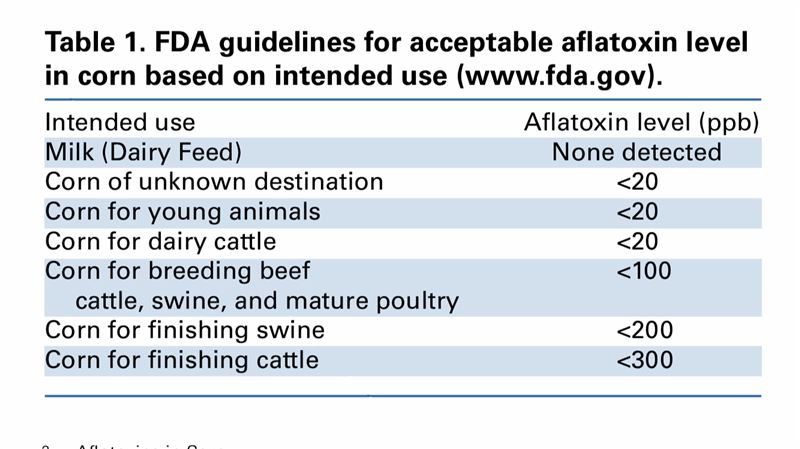
| |
| |
| |


 Folks on-line